 |
 |
 |
 |
 |
 |
 |
 |
 |
 |

| . |  |
. |
EU Still Strong On External Agenda
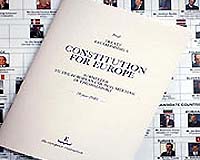
Washington (UPI) June 2, 2005 As the European Union faces the task of rebuilding its political stamina and healing the wounds of rejection caused by the French and Dutch "no" vote against the constitution, European officials stressed to the United States Thursday it is still the same Europe it was a month ago. "The determination of the European Union countries and the European Union institution is the same: to continue trying to work to solve these problems, to do it with our friends, to do it in cooperation with the United States," said EU High Representative Javier Solana, during a joint news conference with Secretary of State Condoleezza Rice at the U.S. State Department Thursday. European officials including Solana, EU Foreign Minister Jean Asselborn and EU External Relations Commissioner Benita Ferrero-Waldner met Thursday with Rice in a ministerial meeting to prepare for the upcoming U.S.-EU summit in Washington on June 20. Both Rice and European officials outlined the agenda for the upcoming summit that is intended to showcase strong trans-Atlantic relations with continued efforts to promote peace and democracy in Iraq and Lebanon, a two-state solution to the Israeli-Palestinian conflict, and a halt to Iran's uranium enrichment program. "Europe faces important questions about its future course and this is, of course, a matter for Europeans to decide," said Rice. "But I do want to say that the United States is very glad that we have a strong partner in Europe to work on vital issues of peace, of hunger, of poverty, of opportunity and of freedom." However, despite the comprehensive global agenda set out by both partners, the Europeans found themselves convincing their U.S. counterparts and the rest of the world the EU was still on track with a strong external agenda and would not suffer from any setbacks as a result of the two referenda in France and the Netherlands. "The vote in France and now especially in Netherlands, these are real, important, serious setbacks," said Ferrero-Waldner. "(But) we continue to work and nothing does prevent us from carrying all the important work in cooperation with the U.S." "Some people have suggested we will now be too absorbed in our crisis to pursue our external policies. I promise you, this will not be the case," added Ferrero-Waldner. While the rejection by French and Dutch voters of the EU's constitution has caused many to predict its death, European officials in Washington stressed the ratification process would continue after concerns are heard during the next meeting scheduled to take place on June 16. "We can say that Europe is a little bit hesitating," said Asselborn. "People in France and yesterday in the Netherlands, they gave us a message. But Europe is not denied, not rejected, by these two counties but it seems to be misunderstood." "But I stay very optimistic that we can reverse this negative dynamic," added Asselborn. Under the text of the constitution, all 25 member states are required to vote yes before the constitution can be ratified. However, EU officials in Washington said that under chapter four of the constitution, ratification can still be pursued if 20 of the 25 countries agree to pass the treaty. On Wednesday, 62 percent of Dutch voted against the ratification of the document and 38 percent backed it, according to exit polls. Two days earlier in France, 57 percent of voters rejected the EU's treaty. Unlike the French vote, the Dutch vote is not binding. Although the United States has not taken a position on the constitution it has said it wants a strong Europe as a partner that will continue to look outward, not inward. "It is our view that a strong and united Europe that is able to act as a global partner with the United States, given its democratic values and our long history together, will only serve to multiply the forces that are fighting for democracy and freedom and for prosperity across the globe," said Rice. All rights reserved. Copyright 2005 by United Press International. Sections of the information displayed on this page (dispatches, photographs, logos) are protected by intellectual property rights owned by United Press International. As a consequence, you may not copy, reproduce, modify, transmit, publish, display or in any way commercially exploit any of the content of this section without the prior written consent of by United Press International. Related Links TerraDaily Search TerraDaily Subscribe To TerraDaily Express  Analysis: Dutch Put Axe To EU Constitution
 by Gareth Harding
Chief European Correspondent Brussels (UPI) Jun 01, 2005 The Netherlands, one of the six founding members of the EU and traditionally one of its most solid backers, delivered a potentially fatal blow to the bloc's first constitution Wednesday when voters overwhelmingly rejected the treaty. |
|
|
| The content herein, unless otherwise known to be public domain, are Copyright 1995-2016 - Space Media Network. All websites are published in Australia and are solely subject to Australian law and governed by Fair Use principals for news reporting and research purposes. AFP, UPI and IANS news wire stories are copyright Agence France-Presse, United Press International and Indo-Asia News Service. ESA news reports are copyright European Space Agency. All NASA sourced material is public domain. Additional copyrights may apply in whole or part to other bona fide parties. Advertising does not imply endorsement, agreement or approval of any opinions, statements or information provided by Space Media Network on any Web page published or hosted by Space Media Network. Privacy Statement All images and articles appearing on Space Media Network have been edited or digitally altered in some way. Any requests to remove copyright material will be acted upon in a timely and appropriate manner. Any attempt to extort money from Space Media Network will be ignored and reported to Australian Law Enforcement Agencies as a potential case of financial fraud involving the use of a telephonic carriage device or postal service. |