|
The United States has licensed Boeing's satellite systems division to explore a tie-up with the Indian Space Research Organization to build a communication satellite.
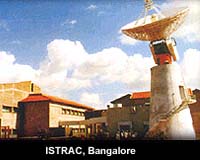
India's space agency, the Indian Space Research Organization, said it plans to build a commercial communications satellite by mid-2006.
Scientists, government officials and business leaders from India and the United States are currently participating in a five-day India-U.S. Conference on Space Science, Applications and Commerce in Bangalore.
U.S. Undersecretary for Commerce Kenneth Juster said Washington is keen to see stronger commercial links with India on space technology.
"We need to advance cooperation in high-tech trade, civilian space activities in ways that do not undermine the general international framework on non-proliferation," he said.
"Together, the United States and India have the potential to transform the future into a safer, more prosperous tomorrow. Together, our countries can harness civil space cooperation for the lasting benefit of all humankind," Juster said at the conference, adding, "The seeds of that cooperative effort have already been planted."
Juster said that from October 2001 through September 2002, the United States approved 423 license applications for dual-use exports to India, valued at almost $27 million. These license approvals represented approximately 84 percent of all licensing decisions for India that year.
The two sides are also discussing expansion of the "Memorandum of Understanding for Science Cooperation in the Areas of Earth and Atmospheric Sciences."
The agreement could boost an Earth observation program and improve weather and climate forecasting in India with the two nations sharing satellite data and other environmental research.
"Our countries face similar challenges in protecting our populations from the ravages of floods, drought and other weather disasters, said retired Brig. Gen. John J. Kelly Jr., National Ocean and Atmospheric Administration's deputy undersecretary of commerce for oceans and atmosphere.
"We are working together to find ways both nations can work together toward the same goal, which is to save lives and shield the economies," Kelly said in a statement.
The memorandum, first signed in 1997 and extended in 2002 for five more years, provides for the near-real-time exchange of U.S. and Indian geostationary and other satellite data under a cooperation program in the earth and atmospheric sciences.
"Futu re cooperation between India and the United States in space science and applications" will also be discussed at the conference, NASA Deputy Administrator Frederick Gregory said in the statement.
Space cooperation between India and the United States dates back to 1963 with an atmospheric experiment on a U.S.-made rocket.
Indian Prime Minister Manmohan Singh said in a message to the conference participants that mutual trust between India and the United States was key to a strategic partnership in high-tech areas, including commerce.
"India and the United States recognize that there is a vast scope for bilateral high technology commerce, including civilian space commerce," Singh said in the message.
Despite the lifting of most of the sanctions, the United States continues to retain two top Indian organizations on its watch list for the export of dual-use technologies.
Juster told reporters in Bangalore that two Indian organizations along with 14 of their subordinate units need additional licensing requirements to import dual-use technologies for their projects. He, however, did not reveal the names.
"Their licensing applications are dealt on a case-by-case basis, as we do with similar applications even from our close allies, including Japan and the U.K.," Juster said.
Top Indian space and defense officials hinted subdivisions of two organizations -- the Indian Space Research Organization and the Defense Research and Development Organization -- were affected by U.S. sanctions imposed in the wake of India's May 1998 nuclear tests.
Relations between New Delhi and Washington have warmed up in the past few years since the United states lifted most of the sanctions slapped on India's nuclear and space programs following New Delhi's nuclear test blasts in 1998.
All rights reserved. Copyright 2004 by United Press International. Sections of the information displayed on this page (dispatches, photographs, logos) are protected by intellectual property rights owned by United Press International. As a consequence, you may not copy, reproduce, modify, transmit, publish, display or in any way commercially exploit any of the content of this section without the prior written consent of by United Press International.
Related Links
 Voters Delete India's Cyber Savvy MP As Voters Desert Government
 New Delhi (UPI) May 12, 2004