bye
bye |
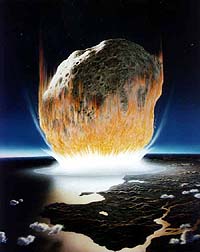
But that's not so. A group of geologists working in southern China found evidence that it was an asteroid or a comet that smacked our planet, exploded, and then caused the most severe biotic crisis in the history of life on Earth.
In the September issue of Geology, Kunio Kaiho from Tohoku University reports their findings of a remarkable sulfur and strontium isotope excursion at the end of the Permian, along with a coincident concentration of impact- metamorphosed grains and kaolinite and a significant decrease in manganese, phosphorous, calcium, and microfossils (foraminifera).
Their discoveries at Meishan (Mei Mountain) suggest that an asteroid or a comet hit the ocean at the end of the Permian, triggered a rapid and massive release of sulfur from the mantle to the ocean-atmosphere system, swooped up a significant amount of oxygen, precipitated acid rain, and possibly set off large-scale volcanism.
"Understanding the cause of this event is important because it represents the largest mass extinction," Kaiho said, "and it led to the subsequent origination of recent biota on Earth."
Kaiho discovered the significance of the site when he took samples from it in 1996 and again in 1998. He plans to investigate other evidence of impact events.
"We would like to clarify paleoenvironmental changes and causes of the end Permian mass extinction in different places and of the other mass extinctions which occurred during the past 500 million years: end Ordovician, Late Devonian, and end Triassic," he said.
Related Links
 Advancing Our Understanding of Life
 Washington - Aug 21, 2001