|
 |
 |
 |
 |
 |
 |
 |
 |
 |

| . |  |
. |
Fossil Patagonian Plants Show High Insect Feeding Diversity 52M Years Ago
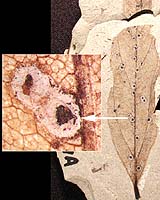
South America has the most biodiversity of any major region today and according to an international team of researchers, that biodiversity began at least 52 million years ago. "What defines terrestrial ecology is plant insect interactions," says Dr. Peter Wilf, assistant professor of geosciences and the John T. Ryan Jr. Faculty Fellow. "But there is very little information about the history of insects eating plants in South America, despite the tremendous number of plant and animal species there today. This study provides the first window to the past on the South American continent's ancient diversity and abundance of insects on plants 52 million years ago. This ancient biodiversity is a legacy that will help us understand today's South American diversity." Wilf, working with Conrad C. Labandeira, National Museum of Natural History, the Smithsonian Institution; Kirk R. Johnson, Denver Museum of Nature & Science, and N. Ruben Cuneo, Museo Paleontologico Egidio Feruglio (MEF), Trelew, Argentina, looked at plant diversity and insect feeding richness on fossil plants and compared fossil leaves collected at Laguna del Hunco, Patagonia, Argentina, that date to the globally warm Eocene, with fossil leaves collected at three Eocene sites in North America � Republic, Washington; Green River, Utah; and Sourdough, Wyoming. The researchers looked at the types and amounts of insect consumption on the fossilized leaves at all four locations. "All four floras are very rich in fossil plant species and the Laguna del Hunco flora is the most diverse of the group," Wilf says. They report in today's (June 20) online version of the Proceedings of the National Academy of Sciences that by 52 million years ago, plants and insects in Patagonia were more diverse and abundant than those at that time in North America. "We still do not know when Patagonia became that diverse," says Wilf. "We have to go back in time some more to find the beginning of increased diversity." The researchers were very careful in the field to ensure they achieved an unbiased sample. They also used computerized resampling methods to eliminate any possible bias from unequal sample sizes. "We used identical collection methods for all the fossil leaf collections," says Wilf. "For example, Kirk Johnson and his crews collected the fossils at both Green River and Republic and he also was on our Patagonia expeditions, so we can easily compare the samples. In collecting, we count every leaf that we find and we collect every identifiable leaf that has insect damage. Conrad Labandeira and I scored all of the thousands of leaves from the four fossil floras for insect damage using the same proceedures." The researchers took the 3599 specimens collected in Patagonia from 25 quarries. The fossils are housed at the MEF in Trelew which Ruben Cuneo directs. These fossil leaves grew during the Eocene global climatic optimum, the warmest time period in the last 70 million years. During this time, there were no polar ice caps and alligators were found above the Arctic circle. The researchers classified damage by feeding group and damage type. The four feeding groups are those insects that feed on the external leaf, chewing holes, edges and other leaf parts; those insects that mine tissues inside the leaf; those that produce bulbous galls and those that pierce and suck the leaves. Because different insects chew, mine, gall and pierce in different ways, the researchers recognized 52 discrete damage types from the four feeding groups. They applied these categories to both bulk samples from single quarries and to individual leaf species. The insect damage on the 3599 fossil leaves from Patagonia was compared to the 1019 fossil leaves from Republic, 894 leaves from Green River and 792 leaves from Sourdough. The Republic site is the most similar to the Laguna del Hunco site in terms of volcanic setting, age, environment and distance from the coast. After adjusting for sample size, the Republic site also is the most diverse in plant species of the North American sites and has diverse feeding damage. The researchers found that the number of damage types at each of the four major Patagonian quarries significantly exceeds each of the three North American samples. The number of functional feeding groups is also greater than all North American samples for three of the four major quarries. The diversity of damage types and feeding groups at the Patagonian sites for individual plant species hosts is also highest. "Insect damage on leaves, the remains of insect meals, is uniquely valuable data," says Wilf. "While actual insect fossils can give us taxonomic information, leaf damage provides unique ecological data about which and how many kinds of insects were eating and interacting with ancient plant species in the deep past. Also, insect damage on fossil plants, which can be very abundant, can give us a great deal of information about insects at times and places with very few insect fossils." Finding insect fossils is rarely easy. Fewer than 100 fossil insect species have been described from South America for the past 65 million years, including a handful from Laguna del Hunco. The recent Laguna del Hunco survey recorded about 100 new insect fossils, which are now under study to determine which and how many species they represent. This scarcity of insect information can be mitigated by looking at the fossilized remains of what the insects had for dinner. The current evidence from South America suggests that there were a large number of different insect lineages feeding on a large number of plant species. "There was tremendous diversity and abundance of insects and plants in the Eocene," says Wilf. "Insects depend on plants to survive. If you have diverse plants, you get diverse animals. We know that plant and insect diversity are linked today and our study shows that plant and insect diversity were linked in the past as in today's South America." Related Links Penn State TerraDaily Search TerraDaily Subscribe To TerraDaily Express  Super Predators And Mass Extinctions
 Washington DC (SPX) Jun, 16, 2005
Mass extinctions seem to occur on Earth roughly every 26 million years, leading some scientists to propose that they may be caused by rare collisions with comets or asteroids. A researcher in Poland thinks it may be possible that extraordinary predators are at fault instead. |
|
|
| The content herein, unless otherwise known to be public domain, are Copyright 1995-2016 - Space Media Network. All websites are published in Australia and are solely subject to Australian law and governed by Fair Use principals for news reporting and research purposes. AFP, UPI and IANS news wire stories are copyright Agence France-Presse, United Press International and Indo-Asia News Service. ESA news reports are copyright European Space Agency. All NASA sourced material is public domain. Additional copyrights may apply in whole or part to other bona fide parties. Advertising does not imply endorsement, agreement or approval of any opinions, statements or information provided by Space Media Network on any Web page published or hosted by Space Media Network. Privacy Statement All images and articles appearing on Space Media Network have been edited or digitally altered in some way. Any requests to remove copyright material will be acted upon in a timely and appropriate manner. Any attempt to extort money from Space Media Network will be ignored and reported to Australian Law Enforcement Agencies as a potential case of financial fraud involving the use of a telephonic carriage device or postal service. |