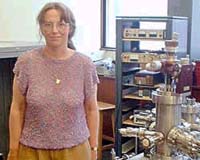
Dr Lidija Siller in her material science lab at Newcastle University
Dr Lidija Siller in her material science lab at Newcastle University |
Gold is used extensively in the electronics industry, as a conductor of electricity in products such as computers, mobile phones and smart cards. This is because it is relatively stable when exposed to the atmosphere.
However, gold is also one of the most expensive metals on the market, and is therefore combined with other, cheaper substances such as nickel, iron and colbalt salt before it is used in order to improve hardness.
Newcastle University's Dr Lidija Siller, who has created the gold nitride, believes it could be harder and more durable than current gold alloys - which could mean a much thinner gold plating layer could be applied to products, thus reducing manufacturing costs.
Further tests need to be carried out, however, to fully assess its potential.
Dr Siller, of the School of Chemical Engineering and Advanced Materials, used a technique called ion implantation to create the material.
She placed the gold in an experimental chamber under ultra high vacuum, cleaned it with argon and then heated up the gold crystal. This was then irradiated with nitrogen ions using a spattering gun. As it is invisible to the naked eye she then checked whether gold nitride had been formed by looking at it using X-ray techniques.
Dr Siller, who began her experiments with gold nitride in 2001, said: "I am starting to investigate its properties and to see how it performs in terms of conductivity and durabililty.
"Early indications suggest that it will certainly be cheaper to manufacture, as nitrogen makes up 80 per cent of the atmosphere around us.
"It is harmless and does not provide a pollution risk unlike some of the metals which are usually mixed with gold, such as arsenic, lead or colbalt."
Previous attempts to make gold nitride failed because they were based on scientists' misunderstanding of the kinetic reaction between gold and nitrogen, Dr Siller said.
The University has filed a patent for the gold nitride process whilst Dr Siller is attempting to make further modifications to the substance to test whether it will have widespread use in industry.
Related Links
 New Software Can Increase Fiber Optics Capacity Four-Fold
 Melbourne Fl - Oct 22, 2003