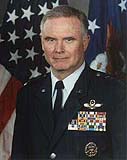
Acknowledging that "weaponizing space" has huge policy implications, General Michael Ryan said growing US reliance on space will force Washington to confront decisions on whether to use space both defensively and offensively.
Acknowledging that "weaponizing space" has huge policy implications, General Michael Ryan said growing US reliance on space will force Washington to confront decisions on whether to use space both defensively and offensively. |
Acknowledging that "weaponizing space" has huge policy implications, General Michael Ryan said growing US reliance on space will force Washington to confront decisions on whether to use space both defensively and offensively.
"I would say that eventually we are going to have to have the capability to take things out in orbit," Ryan said at a breakfast with defense reporters.
No possibility should be excluded, he said, mentioning space-based lasers, anti-satellite weapons, space bombers.
"When we are so dependent (on space), and when others become dependent on it, it becomes I think a region of tension," he said. "We better not be second."
Once a taboo subject, talk of a coming militarization of space has become more open in US military circles since Defense Secretary Donald Rumsfeld took office.
In one of his first actions, Rumsfeld put the air force in charge of organizing, training and equipping the military for both offensive and defensive operations.
The air force plans to demonstrate a space-based laser in a decade, Ryan said.
The US Space Command has been charged to be prepared to have an anti-satellite capability, he said.
US reliance on satellites for intelligence, communications, reconnaissance, weather monitoring, and navigation has grown to such an extent that "should we lose them it would be a huge blow," said Ryan.
"I think we have to protect them in some way, at least defensively," he said. "And that leads you to the thought that if you're going to be up there trying to protect them defensively, where do you cross the line on offensive operations," he said.
"I have to say, just historically, wherever commerce has gone and our national interests have gone, so have gone our forces," he said.
Related Links
 AFA Conference Brings Space Stars Together
 Colorado Springs - June 25, 2001
 Washington (AFPN) May 9, 2001
Washington - April 9, 2001
Washington (AFPN) May 9, 2001
Washington - April 9, 2001