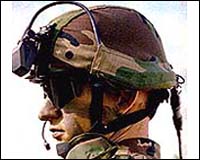
photo by Jim Caldwell
photo by Jim Caldwell |
The gadget is an easy-to-use computer that the Pentagon has baptised JEDI, for Joint Expeditionary Digital Information, the British scientific weekly reports in its upcoming issue due out on Saturday.
JEDI combines laser rangefinding, GPS satellite positioning, a satellite phone and text messaging in a robust "super-palmtop" controlled by Microsoft's Windows CE operating system.
The computer is hooked up to laser rangefinding binoculars. A spotter on the ground who, for instance, sees a target vehicle uses the binoculars to get a reading of its position, speed and direction of travel.
The data is collected automatically by the pocket PC. All the soldier has to do is identify the type of vehicle by pointing to simple icons on the screen.
The computer then codes the information into a short text message, which is sent via the Iridium satellite phone system to forward headquarters or a nearby attack aircraft.
The system is much faster than the current form of communication, which requires spotters to call in the coordinates by radio and to describe targets verbally.
That process can take up to a minute, which often enables fast-moving vehicles, such as mobile rocket launchers, to be out of sight by the time the strike plane shows up.
Using JEDI, the time to get the targeting message across is reduced to as little as three seconds.
JEDI's inventors contend it can also eliminate targeting targeting errors that arise when there is miscommunication about the description of a vehicle or when troops transmit the wrong coordinates of a target building.
All rights reserved. � 2002 Agence France-Presse. Sections of the information displayed on this page (dispatches, photographs, logos) are protected by intellectual property rights owned by Agence France-Presse. As a consequence, you may not copy, reproduce, modify, transmit, publish, display or in any way commercially exploit any of the content of this section without the prior written consent of Agence France-Presse.
Related Links
 Oak Ridge Building Future Soldiers
 Oak Ridge - Feb. 21, 2002