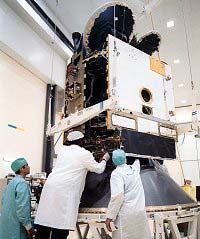
A Skynet Bird
A Skynet Bird |
Europe launched an array of scientific and applications-oriented programs, eventually generating results on a par with other space powers. Today, for example, European satellite manufacturers have caught up with the long-time leaders in the United States.
In the defense sector, however, Europe's ambitions and resources have always been more restrained than their Russian or American counterparts. But Ariane has still played a vital role in the development of Europe's military space capability, enabling Europe to affirm its political autonomy in international crisis management.
Arianespace has launched nearly all European military spacecraft, in particular the British Skynet 4B (Dec. 1988), 4C (Aug. 1990) and 4E (Feb. 1999) communications satellites, France's Telecom 2 series, which carries the Syracuse military communications payload (Dec. 1991 to Aug. 1998), and the Helios 1A and 1B observation satellites (July 1995 and December 1999) for program partners France, Italy and Spain.
On February 7, for the first time, Arianespace will launch two military satellites on a single mission. An Ariane 44L will carry into orbit the Sicral satellite for Italy and Skynet 4F for the U.K., confirming Ariane's role as one of the keystones in a pan-European defense policy.
The history of launch services in other countries clearly illustrates the sector's decisive importance in developing a national security policy. In the United States, for instance, the responsibility for both launch vehicle programs and launch sites was assigned to the Department of Defense.
Recent conflicts in the Gulf and the Balkans have amply proven the importance of space-based systems for intelligence, communications and navigation. Europe is ready to rise to this strategic challenge, by calling on the proven Ariane launch system, a veteran of 138 missions, and a launch base offering the security needed to handle classified missions. Whether serving civilian or defense markets, Ariane has met its objectives.
Related Links
 Alcatel To Build French Milspace Comm Bird
 Paris - Dec. 8, 2000