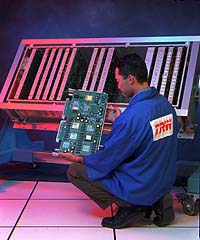
Milstar's EHF Processor
Milstar's EHF Processor |
SMART-T is a highly mobile EHF SATCOM system deployed on a High Mobility Multipurpose Wheeled Vehicle. Designed to work with the Milstar satellite constellation, the terminal allows widely dispersed warfighters to exchange information with low probability of detection and low probability of interception. Its primary mission is to support field commanders with global, robust, jam-resistant and secure communications.
The U.S. Army's Communications and Electronics Command, Ft. Monmouth, N.J., issued the award. Under provisions of the cost plus fixed-fee contract, Raytheon will design, develop, integrate and test three prototype retrofit kits on SMART-T terminals.
Future plans include retrofitting all existing SMART-Ts and integrating the kit on new systems as they come off the production line. The Department of Defense's fleet is expected to number approximately 330 SMART-T systems by 2005.
U.S. Army Military Satellite Communications Project Manager Henry Jehan said, "The AEHF upgrade will allow our SMART-Ts to communicate with the AEHF constellation at data rates 400 percent higher than those available via Milstar Medium Data Rate (MDR) satellites. Higher transmission rates mean better information security and faster delivery of essential military communication."
Bill Puzella, vice president of Raytheon Satellite Communications, said, "Although the AEHF architecture is similar to the one we used for MDR, the retrofit package offers advancements in modem speed, amplifier performance and modulation techniques."
SMART-T is designed in Marlborough, Mass., and produced in Largo, Fla. Launched from Cape Canaveral, Fla., on February 27, 2001, the first Milstar II MDR satellite and its highly secure, anti-jam communications payload reached its parking space on March 13th.
On that date, SMART-T became the first system to log-on to Milstar II's MDR transponder and pass live communication traffic between space and Earth.
The first of two low data rate Milstar I satellites was launched in 1993. Earlier this year, the first of four Milstar II medium data rate satellites, went into space.
AEHF, the next generation of Milstar satellites, promises transmission speeds that will outstrip the capabilities of Milstar I and Milstar II. It is slated for launch in 2005-06.
Related Links
 First Milstar II Bird Start On-orbit Testing
 Sunnyvale - March 29, 2001