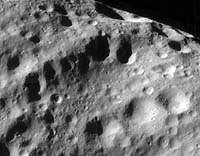
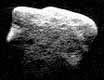
The NEAR Shoemaker spacecraft - the first to orbit an asteroid - embarks on a series of low-altitude passes over 433 Eros this month in a prelude to its daring February descent to the surface of the rotating, 21-mile-long space rock.
The orbit segment of NASA's Near Earth Asteroid Rendezvous (NEAR) mission wraps up Feb. 12 with NEAR Shoemaker's controlled descent to Eros, a tricky maneuver that will allow the craft's digital camera to snap close-ups of the asteroid's cratered, boulder-strewn landscape. But the weeks before the historic event won't be much easier, as NEAR mission operators and navigators take the spacecraft on several low passes over the ends of the potato-shaped Eros from Jan. 24-28.
"NEAR Shoemaker is nearly out of fuel, and by the end of January it will have completed its scientific objectives at Eros," says Dr. Robert W. Farquhar, NEAR Mission Director at The Johns Hopkins University Applied Physics Laboratory in Laurel, Md. "The maneuvers are kind of risky, but we want to end the mission getting a lot of bonus science - with images better than we've ever taken."
On Jan. 24, NEAR Shoemaker will dip from its current 22-mile (35-kilometer) circular orbit to begin a four-day series of flyovers. The spacecraft will complete five to six passes, each within about 3 to 4 miles (5 to 6 kilometers) of the surface. In the early hours of Jan. 28 the spacecraft will zip between 1 to 2 miles (2 to 3 kilometers) over the surface - closer than it has ever come before.
"The flyovers will give us a detailed look at the surface, much like we saw when the spacecraft came within 3 miles of Eros during the first low flyover in October," says NEAR Project Scientist Dr. Andrew F. Cheng, of the Applied Physics Laboratory. "This time we're going over different areas, so we can find out if the small-scale geological features we saw in the earlier images are typical of the surface."
The spacecraft will swing out from that low pass back to a 22-mile orbit, where it will stay until the controlled descent. Mission designers are working out the final details of the descent, but they plan to slow the craft's fall with several intermittent engine burns.
NEAR Shoemaker's telescopic camera will gather high-resolution images during the last 3 miles of the maneuver, until about 1,650 feet (500 meters) above the asteroid. Before touching down near Eros' distinctive "saddle" depression, NEAR Shoemaker could deliver images showing features as small as 4 inches (10 centimeters) across.
"NEAR Shoemaker was never designed to land, so that's not the main goal of the controlled descent," Farquhar says. "The definition of success here is getting the close-up images. We're not optimizing this maneuver to ensure the spacecraft survives this event."
The first launch in NASA's Discovery Program of low-cost planetary missions, NEAR Shoemaker has been in orbit around Eros since Feb. 14, 2000, conducting the first in-depth study of an asteroid.