EROSDAILY
Nose-to-Nose With An Asteroid

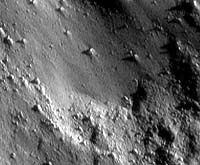
NEAR Shoemaker took this picture at 8:45 p.m. EST on January 25, 2001, during one of the spacecraft's low-altitude passes over the surface of Eros. The distance to the center of the picture is only 9 kilometers (5.6 miles), so the entire scene is a mere 340 meters (1,120 feet) across. At this scale, we can distinguish features less than 2 meters across. The asteroid's surface appears nearly devoid of obvious craters and is instead dominated by small boulders. In the upper left part of the image, a smooth deposit with a lower density of boulders is in contrast to the very rough-textured material seen at the lower right.
Laurel - January 28, 2001
The NEAR Shoemaker spacecraft made history once again today when it brushed over the "toe" end of Eros, less than two miles (2.74 kilometers) from its surface, at 5:41 a.m. EST (ground receive time).

The daring pass-the closest any spacecraft has come to an asteroid-marked the conclusion of a 4-day series of low-altitude flyovers that is returning extraordinarily detailed images of the asteroid's surface.

The low pass sequence ended this afternoon at 1:22 p.m. EST (ground receive time), when a 3.8-second burst from the spacecraft's 5-pound thrusters pulled it away from its breathtaking vantage point, and back toward an orbit 22 miles (35 kilometers) above the asteroid.

There it will remain circling Eros until a maneuver on Feb. 12 pulls the spacecraft out of orbit and into position for its descent to the asteroid. Several more engine burns will slow NEAR Shoemaker's descent, allowing it to settle on to the asteroid's surface at about 3 p.m. EST.

Related Links
NEAR Mission
TerraDaily
Search TerraDaily
Subscribe To TerraDaily Express

EROSDAILY
NEAR Spectrometer Team Go To Work
Laurel - Jan. 22, 2001
The yearlong orbit is quickly drawing to a close, but it's the best time of the mission for the NEAR X-Ray/Gamma-Ray Spectrometer team. With NEAR Shoemaker circling about 22 miles above Eros through most of January, XGRS scientists have been exploring the elements on - and for the first time, below - the asteroid's surface from the instruments' prime operating distance.