|
 |
 |
 |
 |
 |
 |
 |
 |
 |

| . |  |
. |
China Says Decision Expected Soon On International Nuclear Tenders
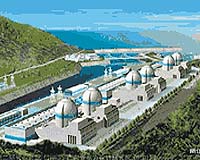
A decision on who wins the right to build four 1,000 megawatt nuclear power plants is expected soon and political considerations will not play a part, China's top nuclear industry executive said Monday. "We are in the midst of technical exchanges with America's Westinghouse, France's Framatome (a subsidiary of Areva) and Russia's AtomStroyExport," Kang Rixin, general manager of the state-owned China National Nuclear Corporation (CNNC) told journalists. The three manufacturers tendered bids early this year for the third generation multi-billion dollar reactors with a pair to be built in Sanmen in the eastern province of Zhejiang and Yangjiang in Guangdong province. "We are making efforts to analyze the tender documents put forward by these three companies and still have some issues that we need to understand like matters concerning technical levels, technical transfers and pricing, which is a sensitive issue," Kang said. "If everything goes smoothly, then I think that we will be able to quickly make the decision." Political considerations for the eventual winner or winners were not being made during the decision-making process at CNNC, Kang said. "The purpose of CNNC is to contribute to the economic development of China by developing nuclear power, from my perspective in such a process there is no such thing as political considerations," he said. "As long as the technology concerned is conducive to the economic development of China, then we will choose to use this technology." He did not comment on what influence the State Council, China's cabinet, or the planning ministry would have in the decision-making process. China presently has nine nuclear power plants in operation, with two more Russian-made plants expected to go on line by early next year, and eight other plants already having the central government approval, Kang said. China currently gets just 2.3 percent of its energy from nuclear power plants and is hoping to increase that to 4.0 percent by 2020, which will make it the world's fastest developer of nuclear power. To achieve this, China plans to increase its nuclear generating capacity from the current 8,700 megawatts to 36,000 megawatts by 2020, equal to the construction of a 1,000 megawatt nuclear reactor a year. All rights reserved. � 2005 Agence France-Presse. Sections of the information displayed on this page (dispatches, photographs, logos) are protected by intellectual property rights owned by Agence France-Presse. As a consequence, you may not copy, reproduce, modify, transmit, publish, display or in any way commercially exploit any of the content of this section without the prior written consent of Agence France-Presse. Related Links TerraDaily Search TerraDaily Subscribe To TerraDaily Express  EU, US Stand Firm On Iran Abandoning Nuclear Fuel Cycle Work: Diplomats
 Vienna (AFP) Jun 04, 2005
The EU and the United States remain committed to Iran giving up uranium enrichment work that could be used to make atomic weapons and want to clear up any confusion over this with Tehran, diplomats said Saturday. |
|
|
| The content herein, unless otherwise known to be public domain, are Copyright 1995-2016 - Space Media Network. All websites are published in Australia and are solely subject to Australian law and governed by Fair Use principals for news reporting and research purposes. AFP, UPI and IANS news wire stories are copyright Agence France-Presse, United Press International and Indo-Asia News Service. ESA news reports are copyright European Space Agency. All NASA sourced material is public domain. Additional copyrights may apply in whole or part to other bona fide parties. Advertising does not imply endorsement, agreement or approval of any opinions, statements or information provided by Space Media Network on any Web page published or hosted by Space Media Network. Privacy Statement All images and articles appearing on Space Media Network have been edited or digitally altered in some way. Any requests to remove copyright material will be acted upon in a timely and appropriate manner. Any attempt to extort money from Space Media Network will be ignored and reported to Australian Law Enforcement Agencies as a potential case of financial fraud involving the use of a telephonic carriage device or postal service. |