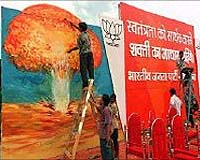
no more fake nuclear spats
no more fake nuclear spats |
India's Foreign Minister Natwar Singh said Tuesday that senior diplomats of the two nations would discuss the disputed region of Kashmir and measures to improve nuclear security.
Singh said experts from both countries would first meet on June 19 and 20 in talks on nuclear confidence-building measures. "Foreign secretaries will meet on June 27 and 28," he said.
India's Congress Party-led coalition government has vowed to pursue the peace process launched by the outgoing government led by former Prime Minister Atal Behari Vajpayee.
However, Vajpayee's government's defeat in the recent federal elections had led to fears that the bilateral talks might be derailed.
The Congres! S Party, which has ruled India for most of the four decades after independence in 1947 and led the country into three wars with Pakistan, has expressed willingness to overcome the past.
"The future of India-Pakistan relations no longer lies in the past," Singh said. "We cannot forget the past, but neither should we be prisoners of the past."
"The relationship should be based on trust and not mistrust," the minister told reporters in the Indian capital.
Islamabad reacted very sharply last week when Natwar Singh said that the July 1972 Simla Agreement would be bedrock for the India-Pakistan ties. The Simla Agreement was signed after Pakistani troops lost the 1971 war that created Bangladesh.
India believes that the agreement implicitly recognized the Kashmir cease-fire line, known as the Line of Control, as the border with Pakistan.
Pakistani President Pervez Musharraf Saturday reiterated tha! T equitab le dialogue was the only route for a Kashmir solution.
Reacting to Singh's remarks about Simla agreement, Musharraf said, "Well, I believe I am a very pragmatic person. I believe in ground realities. Every agreement is interpreted differently by different people and different governments."
On Monday, Musharraf called Vajpayee and sought his intervention to save the peace process. He said that talks could not be held on the assumption that the Line of Control would be made permanent border.
The two leaders felt that the confidence-building measures, initiated by India and Pakistan in the past few months, should be carried forward and bolstered.
A series of confidence-building measures have been introduced over the past year, including a resumption of rail, air and bus links and a strengthening of diplomatic ties. The Indian cricket team also traveled to Pakistan earlier this year, despite security con! Cerns.
Musharraf urged Vajpayee to use his experience for the good of people of India as well as for the betterment of relations between India and Pakistan.
The bilateral talks were slated for the end of May, but India had sought a latter date so the new government could take over. Natwar Singh's statement on the Simla Agreement was about to throw a spanner in the peace process, but New Delhi played down the remark and fixed the meeting between the diplomats.
"I want to assure our friends in Pakistan ... that we are committed to a deep involvement on every possible issue with them," Natwar Singh said Tuesday.
"We will discuss every possible issue with them."
Last week, Musharraf spoke to Congress Party President Sonia Gandhi and invited her to visit Pakistan. The military leader also spoke to the new Prime Minister Manmohan Singh, who said that peace process would continue despite the chang! E of guar d in New Delhi.
India and Pakistan have shared more than five decades of mistrust, hostility and war over the mainly Muslim Himalayan region of Kashmir. The region, divided between the neighbors since 1947, has sparked two of the three wars.
All rights reserved. Copyright 2004 by United Press International. Sections of the information displayed on this page (dispatches, photographs, logos) are protected by intellectual property rights owned by United Press International. As a consequence, you may not copy, reproduce, modify, transmit, publish, display or in any way commercially exploit any of the content of this section without the prior written consent of by United Press International.
Related Links
 Indian Cricketers Told To Win Over Pakistani Hearts
 New Delhi (UPI) - Mar 10, 2004