illustration only
illustration only |
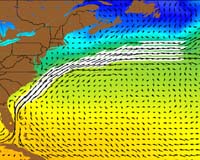
In the current SeaWiFS special issue of Deep Sea Research II, University of Rhode Island oceanographers Stephanie E. Schollaert, Thomas Rossby, and James Yoder describe their four-year, NASA-funded study of the Slope Sea along the Gulf Stream in order to understand the processes that control the yearly variability of surface concentrations of chlorophyll, the pigment found in plants and algae.
Annually, cold, fresh Labrador waters "spill" into the Slope Sea, influencing the path of the Gulf Stream, pushing it south in the spring. Since the advent of ocean color remote sensing in 1978 and particularly since the 1997 launch of the dedicated ocean color sensor SeaWiFS, the surface chlorophyll concentration of waters off the U.S. east coast have been found to be highest in the north (e.g., Gulf of Maine, Georges Bank, Labrador shelf) and during the winter when the Gulf Stream is farthest south and more Labrador water is present.
The scientists expected that during the years when the Slope Sea expanded due to a greater transport of Labrador water, primary productivity, or the production of plankton that forms the basis of the food chain, would be increased. However, their results showed the opposite effect.
The Gulf Stream location determines the area of the Slope Sea and the extent to which nutrients are present. Years when the Gulf Stream is farther south the average chlorophyll concentrations are smaller and vice-versa when the Gulf Stream is offset to the north. An increased number of Gulf Stream rings may also play an important role in supplying additional nutrients to the surface waters.
While the north-south movement of the Gulf Stream is the primary determinant of Slope Sea chlorophyll concentrations, the current's movement may also generate other effects that may influence biological productivity.
Understanding how the Gulf Stream's migration affects biological productivity in the Slope Sea will help scientists make inferences about large-scale, low frequency climatic effects upon the carbon cycle of ocean margin waters.
Related Links
 A Blueprint For US National Ocean Policy For The 21st Century
 Washington DC - Apr 21, 2004