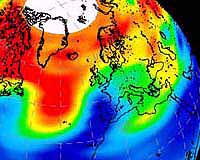
An ozone hole spreads across Spain in winter 2002
An ozone hole spreads across Spain in winter 2002 |
The good kind of ozone
The stratosphere is the layer of the atmosphere from 10 to 30 miles above sea level. When there's ozone in this layer, it protects us from solar radiation. How? Simple chemistry.
Regular oxygen molecules, known to science-types as O2, are made up of two oxygen atoms stuck together. Solar energy shoots in from space and splits that molecule into two atoms. When one of those stray atoms attaches to a full-fledged O2 molecule, you've got, well, O3, otherwise known as ozone. All that action blocks solar radiation, and keeps it from reaching us.
How can solar radiation be harmful to life on Earth? Part of that radiation is ultra-violet, or UV radiation. It's an intense energy from the Sun that can cause a whole lot of damage. Skin cancer is the most dramatic result of a too much UV radiation, but there's a lot more too.
Photosynthesis in plants is also affected, and that causes problems for the whole food chain. See where this is headed? We need to protect our ozone shield, and we can do so by decreasing the pollution that our industrial society puts out in large amounts every day.
The bad kind of ozone
Let's come down a little closer to Earth. The troposphere is everything below the stratosphere, from sea level to about 10 miles above. It's where everything lives. Things that happen to the troposphere happen to us; there's nothing indirect about it.
Put a little ozone in the troposphere and you've got some big problems. Remember those dramatic chemical reactions that happened up in the stratosphere? Living things are made of atoms and molecules too, so when we expose them to ozone, we've got some serious chemical reactions on our hands.
In humans, it means lung damage. Small children and people with asthma are especially at risk. How can you help solve the problem?
Cars, trucks and SUVs are the biggest contributor to this ozone buildup. Engine exhaust creates nitrogen dioxide, so the more you drive, the more your vehicle creates. High gas prices aren't the only reason to leave the car in the garage.
So what now?
NASA's Aura is going to keep tabs on both types of ozone. It's a spacecraft that will provide us the first comprehensive global view of the Earth's atmosphere, an essential stepping stone to better understanding the Moon, Mars and beyond. The launch of Aura is a challenging endeavor, a mission on the cutting edge of scientific discovery characteristic of the Agency's legacy of ground-breaking exploration.
One of its most impressive tools is the Ozone Monitoring Instrument, or OMI. The device will measure the amount of energy going into and coming out of the Earth, in a technique known as the "backscatter" method. The results of these observations will tell scientists how much ozone is over a particular area, and how much the area is gaining or losing over time.
Aura is a complex mission for a complex problem; but simply put, it's critical to understanding and protecting the air we breathe.
Related Links
 Arctic Ozone Loss More Sensitive To Climate Change Than Thought
 Pasadena - Apr 26, 2004