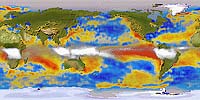
A world view of El Nino
A world view of El Nino |
Writing in the February 15 issue of the journal Geophysical Research Letters, Prof. Allan J. Clarke and Research Associate Stephen Van Gorder of Florida State University describe the model they have developed to predict El Nino using this trigger.
The departure of the wind from its normal seasonal cycle is called a wind "anomaly." The ocean is hypersensitive to zonal (east-west) equatorial wind anomalies.
Analysis of eight El Nino events in equatorial wind data since 1960 shows that these events typically begin in the far western equatorial Pacific as small westerly wind anomalies.
They grow and move eastward to the central equatorial Pacific as the ocean and atmosphere interact to reinforce the anomaly. La Ninas are similarly associated with easterly wind anomalies.
Based on their observation that the wind anomaly in the far western equatorial Pacific typically precedes El Nino or La Nina by about six months, Clarke and Van Gorder developed a model which, in spite of its simplicity, performs as well as, or better than, the leading El Nino prediction models.
Their new model is further improved, they note, by factoring in the east-west movement of the edge of the huge pool of warm water in the western equatorial Pacific. The model also predicts the demise of El Nino and La Nina.
The authors urge further study of the western equatorial Pacific wind anomalies that spark El Nino and La Nina, because these anomalies are at present poorly understood. The study was funded by the National Science Foundation.
Allan J. Clarke and Stephen Van Gorder, "ENSO prediction usingan ENSO trigger and a proxy for western equatorial Pacific warm pool movement," will appear in Geophysical Research Letters, Vol. 28, no. 4 (February 15, 2001), pages 579-582.
Related Links
 Prepare Now for Next El Nino
 Now is the time for vulnerable countries around the globe to begin preparing for the next El Nino, says a UN report. The report issued Oct 27 presents the results of a 19-month study of 16 countries that examined what worked and what didn't in national responses to the forecasts and impacts of the 1997-98 El Nino.