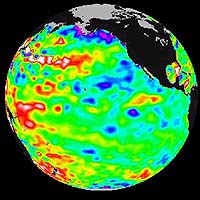
![]() Like fall and winter of 2000, this year�s Topex/Poseidon satellite data shows that the Pacific ocean continues to be dominated by the strong Pacific Decadal Oscillation, which is larger than the El Nino/La Nina pattern. The data, taken during a ten-day collection cycle ending Oct. 29, 2001, show that the near-equatorial ocean has been very quiet in the past year, and sea levels and sea surface temperatures are near normal. Above-normal sea surface heights and warmer ocean temperatures, indicated by the red and white areas, still blanket the far western tropical Pacific and much of the north mid-Pacific. Red areas are about 10 centimeters (4 inches) above normal; white areas show the sea surface height is between 14 and 32 centimeters (6 to 13 inches) above normal. In the western Pacific, the buildup of the Pacific Decadal Oscillation pattern, first noted by Topex/Poseidon oceanographers more than three years ago, has outlasted both the El Nino and La Nina of the past few years. This warmth contrasts with the Bering Sea, Gulf of Alaska and the west coast of the United States, where lower than normal sea surface levels and cool ocean temperatures continue, as indicated by the blue areas. The blue areas are between 5 and 13 centimeters (2 and 5 inches) below normal, while the purple areas range from 14 to 18 centimeters (6 to 7 inches) below normal |
"It is striking how similar October 2001 looks to October 2000," said Dr. William Patzert, an oceanographer at NASA's Jet Propulsion Laboratory, Pasadena, Calif. "Last winter the weather- and moisture-delivering jet stream was steered north by this pattern, resulting in a very chilly, stormy winter in the Midwest and continuing drought on the West Coast."
"Looks like a repeat performance to me," Patzert added.
The Topex/Poseidon data were taken during a 10-day collection cycle ending Oct. 29. They show that the near- equatorial ocean has been very quiet during the past year, and sea levels and sea surface temperatures are near normal. Above normal sea surface heights and warmer ocean temperatures still blanket the far western tropical Pacific and much of the north mid-Pacific.
In the western Pacific, the buildup of the Pacific Decadal Oscillation, first noted by Topex/Poseidon oceanographers more than three years ago, has outlasted both the El Nino and La Nina of the past several years. This warmth contrasts with the Bering Sea, Gulf of Alaska and West Coast, where lower than normal sea surface levels and cool ocean temperatures continue.
"There will be winners and losers in the next few months," said Patzert. "The upper and lower Midwest should expect intermittent blizzards, and the West Coast and Southwest a continuation of below normal rainfall. The outlook is not extreme nor catastrophic."
These data are in line with the U.S. winter forecast issued by the National Oceanic and Atmospheric Administration's National Weather Service. They also show a repeat of last winter's chill across the northern states and relative warmth across the South, with continuing drought in the southeastern states and possibly the western states.
"Next month's launch of the Jason 1 satellite will continue the revolutionary Topex/Poseidon data-gathering with a smaller satellite based on new technologies," said Dr. Lee- Lueng Fu, the Topex/Poseidon and Jason 1 project scientist at JPL. "It will further improve the understanding of ocean circulation and global climate forecasts, as well as provide a key step towards making sea surface height measurement a permanent component of a global ocean observing system in the future."
The joint U.S.-French Topex/Poseidon mission and the Jason 1 program are managed by JPL for NASA's Earth Science Enterprise, Washington, D.C. JPL is a division of the California Institute of Technology in Pasadena.
Related Links
Tucson - Oct 22, 2001
Greenbelt - Sept. 18, 2001
Sydney - June 26, 2001
Pasadena - June 21, 2001