big iron is always profitable
big iron is always profitable |
Saft's Li-ion batteries serve in a wide variety of applications on the ground. Saft's lithium technology has also been selected for the next- generation F-35 (JSF, or Joint Strike Fighter) jet, for which Lockheed Martin is the prime contractor.
And Saft's nickel-hydrogen batteries have a proven track record in GEO service. But this is the first time that a GEO satellite will benefit from Saft's lower-weight, smaller-volume Li-ion batteries.
As GEO satellites fly in an orbit 36,000 km (about 21,000 miles) above the Earth, launch weight and mass are critical factors. By reducing battery weight and space on EADS Astrium's Eurostar E3000 platform, Saft enables Eutelsat to add more revenue-generating transponders to the payload.
In January, Astrium signed a contract with Saft for Li-ion batteries for HotBird 8, another spacecraft in the Eutelsat series. It adds to the list of Li-ion satellite programs that Saft will be working on with Astrium and builds upon the industry's confidence in Saft's technology.
15-year service life
Weighing 4,250 kg at launch, W3A will provide a full range of services in the Ku and Ka bands, including enterprise links, Internet service and television broadcast. Users in W3A's footprint range across Europe, Africa and the Middle East.
W3A's battery is made of Saft's Li-Ion VES 140 cells, which are manufactured in Saft's plant in Bordeaux, France, and assembled into modules and tested at Saft's facility in Poitiers, France. The batteries, as the payload itself, are designed to perform throughout the 15-year service lifetime of the satellite. In fact, this performance requirement is regularly exceeded, even in the tough environment of space.
Like other satellites, the W3A will use its batteries only when it is hidden from the Sun by the Earth. The rest of the time, it will rely on solar panels for electric power of 9,600 watts (DC), even at its end of life.
Although the lifetime of GEO satellites has often exceeded their owners' expectations, resulting in longer revenue streams, they do eventually succumb to the hardships of service in space. The preferred strategic orbits around the Equator are currently full of GEOs that are working successfully for a wide range of owners and operators around the planet.
As the current fleets of GEO satellites are renewed, Saft's lithium-ion batteries remain ready to serve their mission-critical assignment of ensuring reliable performance even in this extremely harsh environment at the same time as they lighten the weight and reduce the volume that batteries need on the payload's platform. W3A is the first of many GEOs that Saft's lithium-ion batteries will fly on. Saft currently has contracts for 13 satellites with lithium-ion batteries.
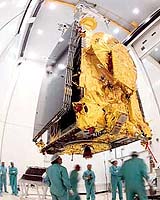
Service-rich space power: With Saft's rechargeable lithium-ion batteries on board, Eutelsat's W3A will deliver a new, broader range of telecoms and broadcast services from its strategic GEO position at 7 degrees East over the Equator.
Related Links
 AsiaSat Buys Fully Integrated Control System From Integral
 Lanham - Feb 16, 2004