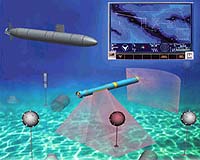
The LMRS -- launched, recovered and maintained from existing U.S. submarines -- has the ability to transit to an area, search it and report back to the submarine and Mine Warfare Commander via satellite every 12 hours over several days.
The LMRS -- launched, recovered and maintained from existing U.S. submarines -- has the ability to transit to an area, search it and report back to the submarine and Mine Warfare Commander via satellite every 12 hours over several days. |
Awarded in November 1999, the LMRS is a five-year, more than $100 million program for Space and Intelligence Systems, a unit of Boeing Integrated Defense Systems, part of Boeing.
The vehicle is an autonomous, underwater surveillance system that consists of two 20-foot long unmanned underwater vehicles; a 60-foot robotic recovery arm; onboard handling equipment; support electronics; a shore-based depot; and a special van to transport the vehicle.
This first system is an engineering development model and will be followed by other production systems. LMRS is scheduled to deploy with Los Angeles- and Virginia-class submarines beginning in 2005.
"The LMRS is another element that supports an interoperable surveillance network, a key part of the integrated battlespace," said Dr. Roger Roberts, senior vice president of Space & Intelligence Systems.
"The Boeing LMRS improves upon earlier systems because it is fully autonomous and untethered and, therefore, frees the host submarine to pursue other missions. Unlike helicopters or ships that can be seen by potential threats, a submarine-based system, like LMRS, allows mines to be located without detection. The information gathered can then be used by the Navy to provide safe routes for ships."
The LMRS -- launched, recovered and maintained from existing U.S. submarines -- has the ability to transit to an area, search it and report back to the submarine and Mine Warfare Commander via satellite every 12 hours over several days.
Related Links
 Robots Powered By The Ocean Itself
 Washington - Oct 09, 2002