|
 |
 |
 |
 |
 |
 |
 |
 |
 |

| . |  |
. |
Could Better Mangrove Habitats Have Spared Lives In The 2004 Tsunami?
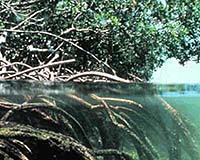
Accounts of the tsunami that killed over a quarter of a million people in Southeast Asia on the 26th of December, 2004, slowly disappear from the media, but the event is nevertheless heavily burned into the memories of those who are directly involved. In the aftermath of the disaster, academics and politicians alike are trying to investigate how the number of casualties could have been reduced and, more important, how such severe damage can be avoided if a tsunami ever strikes again. In an essay published this week in the June 21 issue of Current Biology, a group of researchers recount the first findings arising from their recent assessment of how mangrove ecosystems might have influenced the tsunami's impacts on coastal communities. The research represents a collaborative effort, with participants from the Vrije Universiteit Brussel, Belgium; the University of Ruhuna, Sri Lanka; the Kenya Marine and Fisheries Research Institute; and the Institut Francais de Pondichery, India. Mangrove greenbelts were known to offer some protection against destructive ocean events, such as tsunamis and (far more frequently) tropical cyclones, but they have not always been valued for that function. Economic and political interference, driven by short-term benefit, has been responsible for the destruction of thousands of hectares of mangrove forest (e.g., in East Africa, on the Indian subcontinent, and in Banda Aceh, Indonesia), resulting in the loss of the natural, protective "dyke" function of mangroves in addition to the loss of other services that mangroves provide to local economies and ecosystems. Although many politicians, journalists, and scientists have made post-tsunami statements about the barrier function of mangroves, most have failed to recognize that this function has never actually been investigated in detail. In their essay, the authors present an account of the first post-tsunami field assessment they've undertaken, in Sri Lanka. The researchers investigated the impact of the tsunami at 24 different mangrove sites, comparing the event's effects to the size, history, and quality of the local mangroves. The researchers found that where mangroves occur, they did in fact offer protection from the tsunami. Mangrove fringes near the water's edge appeared to take most of the energy from the tsunami waves, and they showed evidence of damage in some cases, but the researchers found few examples of mangrove trees actually being uprooted. However, mangroves at numerous sites had experienced pre-tsunami degradation. This disruption, resulting from human impact, included "cryptic ecological degradation" (see also Current Biology, March 29, 2005), which involves subtle changes in species composition. From their assessments of the 24 coastal sites, the researchers concluded that even these seemingly minor alterations, which do not necessarily involve a reduction in mangrove area, have had a profound impact on the damage that the 2004 tsunami inflicted on the coastal zone. This puts the drastic clearing of mangroves, and the conversion of mangrove habitats to shrimp farms in other areas, into even starker perspective. The authors highlight the urgent need for a union between management-driven research (research that specifically focuses on environmental aspects that need to be managed) and research-driven management (management that is based on facts from scientific research). The team emphasizes that an early-warning system for mangrove degradation should be seen as being as important for future protection as are early-warning systems for tsunami arrivals; the authors contend that if put in place, such ecological warning systems, along with the restoration of mangroves and other natural defenses, could be more effective in saving human lives and property. The researchers include F. Dahdouh-Guebas and D. Di Nitto of the Biocomplexity Research Team, Laboratory of General Botany and Nature Management, Mangrove Management Group, Vrije Universiteit Brussel (VUB); L.P. Jayatissa of the Department of Botany, University of Ruhuna, Matara, Sri Lanka; J.O. Bosire of the Kenya Marine and Fisheries Research Institute, Mombasa, Kenya; D. Lo Seen of the Institut Francais de Pondichery, Pondicherry, India; and N. Koedam of the Laboratory of General Botany and Nature Management, Mangrove Management Group, Vrije Universiteit Brussel (VUB). The first author is a Postdoctoral Researcher of the Fund for Scientific Research (FWO-Vlaanderen). This research is within the objectives of the International Geosphere-Biosphere Programme (IGBP), Past Global Changes (PAGES) Focus 5: Past Ecosystem Processes and Human- Environment Interactions. Dahdouh-Guebas, F., Jayatissa, L.P., Di Nitto, D., Bosire, J.O., Lo Seen, D., and Koedam, N. (2005). Essay: How effective were mangroves as a defence against the recent tsunami? DOI 10.1016/j.cub.2005.06.008 Publishing in Current Biology, Vol. 15, R443-R447, June 21, 2005. www.current-biology.com Related Links TerraDaily Search TerraDaily Subscribe To TerraDaily Express  Asian Tsunami Means Big Sales For Japanese Satellite Phone Service
 Tokyo (AFP) Jun 17, 2005
A series of disasters including the Indian Ocean tsunamis has meant strong sales for the Iridium global satellite telephone service which has been launched in Japan. |
|
|
| The content herein, unless otherwise known to be public domain, are Copyright 1995-2016 - Space Media Network. All websites are published in Australia and are solely subject to Australian law and governed by Fair Use principals for news reporting and research purposes. AFP, UPI and IANS news wire stories are copyright Agence France-Presse, United Press International and Indo-Asia News Service. ESA news reports are copyright European Space Agency. All NASA sourced material is public domain. Additional copyrights may apply in whole or part to other bona fide parties. Advertising does not imply endorsement, agreement or approval of any opinions, statements or information provided by Space Media Network on any Web page published or hosted by Space Media Network. Privacy Statement All images and articles appearing on Space Media Network have been edited or digitally altered in some way. Any requests to remove copyright material will be acted upon in a timely and appropriate manner. Any attempt to extort money from Space Media Network will be ignored and reported to Australian Law Enforcement Agencies as a potential case of financial fraud involving the use of a telephonic carriage device or postal service. |