|
 |
 |
 |
 |
 |
 |
 |
 |
 |

| . |  |
. |
Kenya's Massive Elephant Transfer Underway As First Group Is Shifted
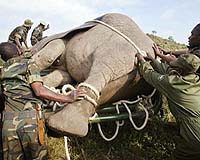
A first family of five elephants was relocated Friday from this overcrowded reserve in Kenya's coastal region, a day after a similar exercise was called off half way through because of bad weather, officials said. The five are among 400 jumbos earmarked for relocation from Shimba Hills National Reserve, where they are being captured and winched into a crate for the 140-kilometer (85-mile) drive to a new home in Tsavo East National Park. "The family includes the matriarch, two young males and two females," said Kenya Wildlife Service (KWS) Elephant Programme Coordinator Patrick Omondi. Normally, a average jumbo family is made up of seven. "While moving the elephants, we are enhancing the conservation of biodiversity," Omondi told reporters at the site of the operation. "And because of the high number of elephants, we had high cases of human-wildlife conflict, so by reducing the numbers, we are going to minimise the conflict within the communities of Kwale." KWS vet Elizabeth Mwanzia explained that first a matriarch (mother-elephant) is shot with an anaesthetic dart. After she had slipped out of consciousness she was normally surrounded by her calves, giving rangers an ample apportunity to hit the whole family with tranquilizers. On Thursday, rangers called off the exercise after capturing a bull when foggy weather hampered helicopter tracking of the animals. "Although yesterday's capture operation was suspended, it served as a good mock run. We were able to ascertain that our equipment and men are up to the task," Omondi said in a KWS statement released here. The 3.2-million-dollar government-funded move has been billed by KWS as "the single largest translocation of animals ever undertaken since Noah's Ark." The aim is to save Shimba Hills, south of the Indian Ocean port of Mombasa, where the elephant population has soared in recent years causing deforestation, according to the agency. Increasing numbers of pachyderms have caused major damage to the rare flora in Shimba Hills and threaten its critical importance as a main water catchment area for the coast, according to KWS. Shimba Hills, 192 square kilometers (74 square miles) in size, is now home to some 600 elephants but can accommodate at most 200, while Tsavo East covers about 13,747 square kilometers (5,307 square miles). Tsavo East experienced its biggest loss from the late 1970s to the early 1990s amid heightening poaching activities, but in the late 1990s the government took tougher action against poachers. In March this year, KWS said the elephant population in the country had jumped by about 10 percent in the past three years to stand at about 30,000 thanks to a severe clampdown on poaching. KWS spokesman Edward Indakwa said round two of the Shimba Hills-Tsavo relocation was expected on Sunday. "After several relocations, we shall establish the rhythm and accurately predict when we shall wind up moving all the elephants. But for now, it has been running very smoothly," he added. The new entrants will be taken to northern part of Tsavo, where the elephant population was badly diminished by poachers in 1970s and 80s. Several game wardens have been deployed there to protect them, KWS said. In addition, KWS said it had taken steps to prevent the elephants from straying on to farmland outside the perimeter of Tsavo, a concern of ranchers in the vicinity that had delayed the planned July start of the operation. All rights reserved. � 2005 Agence France-Presse. Sections of the information displayed on this page (dispatches, photographs, logos) are protected by intellectual property rights owned by Agence France-Presse. As a consequence, you may not copy, reproduce, modify, transmit, publish, display or in any way commercially exploit any of the content of this section without the prior written consent of Agence France-Presse. Related Links TerraDaily Search TerraDaily Subscribe To TerraDaily Express  Jumbo-Size Elephant Relocation In Kenya Hits A Snag
 Shimba, Kenya (AFP) Aug 25, 2005
A planned mammoth-sized relocation of hundreds of elephants from this overcrowded coastal reserve got off to a ceremonial start here on Thursday but immediately hit a hitch as bad weather forced a new delay, officials said. |
|
|
| The content herein, unless otherwise known to be public domain, are Copyright 1995-2016 - Space Media Network. All websites are published in Australia and are solely subject to Australian law and governed by Fair Use principals for news reporting and research purposes. AFP, UPI and IANS news wire stories are copyright Agence France-Presse, United Press International and Indo-Asia News Service. ESA news reports are copyright European Space Agency. All NASA sourced material is public domain. Additional copyrights may apply in whole or part to other bona fide parties. Advertising does not imply endorsement, agreement or approval of any opinions, statements or information provided by Space Media Network on any Web page published or hosted by Space Media Network. Privacy Statement All images and articles appearing on Space Media Network have been edited or digitally altered in some way. Any requests to remove copyright material will be acted upon in a timely and appropriate manner. Any attempt to extort money from Space Media Network will be ignored and reported to Australian Law Enforcement Agencies as a potential case of financial fraud involving the use of a telephonic carriage device or postal service. |