 |
 |
 |
 |
 |
 |
 |
 |
 |
 |

| . |  |
. |
Food Crises In West Africa "Forgotten Emergencies": WFP
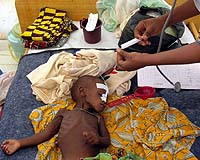
Food crises in Mali and Niger are "forgotten emergencies," senior officials of the World Food Program warned Wednesday, renewing an appeal for assistance that has gone largely ignored by the international community. "There are so many crises in the world, and when there are major crises -- such as the tsunami tragedy in Asia, the humanitarian emergency in the Darfur region of Sudan, there is a tendency to forget these smaller crises," said Jamie Wickens, associate director for operations for the UN agency. "In the rush to react to competing crises, there are some that fall by the wayside, that become forgotten emergencies where, even though they are smaller-scale, are no less important for their impact on populations is just as devastating." In good years, the agro-pastoral zones of Mali and Niger are the breadbasket for the Sahel region, producing ample crops of millet and sorghum to help feed not only their own 25 million people but other surrounding nations. But the parched soil has yielded little in the last five years, due to successive droughts and inconsistent rains. Last year's invasion of desert locusts only compounded an already difficult agricultural situation, sending cereal deficits in both countries into the hundreds of thousands of tonnes. Prices have soared on staple goods, helped along in Niger by a 19-percent tax imposed in January that has since been lifted after massive public protests. Mali, too, has suffered from price hikes for staples, which, coming into the planting season, place an even greater burden on the shoulders of people already scratching out an existence in two of the world's poorest countries. "This is already the most difficult time of the year, even in good years when stocks are plentiful," said Gian Carlo Cirri, WFP country director for Niger. "A lot of these people have nothing more to give. The situation is extremely serious; it is not yet a famine but if we do not get the resources we, and our partners, require, if we are not able to do anything, we will likely face a famine." Complicating the situation further are rising prices for imported cereals, most of which are coming from northern Nigeria as the African giant has so far been spared from drought and swarm. Cirri said that prices for imported millet are "double" what they should be, when transport and red tape are figured in, and even then Nigerian authorities are less than eager to ship their stocks out for fear of being unable to meet the national demand. Eleven million dollars (nine million euros) are needed to replenish dwindling national food stocks in both Mali and Niger, support the school feeding and food-for-work programs sponsored by WFP and other humanitarian partners. So far, according to Wickens, just one quarter of those funds have trickled in. "The timing is pretty crucial, because we hope that within four months, when it's harvest time, there will be less of a need for our assistance," he said. "But until then, what are these people going to do?" All rights reserved. � 2004 Agence France-Presse. Sections of the information displayed on this page (dispatches, photographs, logos) are protected by intellectual property rights owned by Agence France-Presse. As a consequence, you may not copy, reproduce, modify, transmit, publish, display or in any way commercially exploit any of the content of this section without the prior written consent of Agence France-Presse. Related Links TerraDaily Search TerraDaily Subscribe To TerraDaily Express  G8 Arms Trade Undercutting War On Poverty: Campaign Group
 London (AFP) Jun 22, 2005
Efforts by the Group of Eight leading industrialised nations to eradicate poverty in the developing world are being undermined by their own weapons sales, a campaign group said Wednesday. |
|
|
| The content herein, unless otherwise known to be public domain, are Copyright 1995-2016 - Space Media Network. All websites are published in Australia and are solely subject to Australian law and governed by Fair Use principals for news reporting and research purposes. AFP, UPI and IANS news wire stories are copyright Agence France-Presse, United Press International and Indo-Asia News Service. ESA news reports are copyright European Space Agency. All NASA sourced material is public domain. Additional copyrights may apply in whole or part to other bona fide parties. Advertising does not imply endorsement, agreement or approval of any opinions, statements or information provided by Space Media Network on any Web page published or hosted by Space Media Network. Privacy Statement All images and articles appearing on Space Media Network have been edited or digitally altered in some way. Any requests to remove copyright material will be acted upon in a timely and appropriate manner. Any attempt to extort money from Space Media Network will be ignored and reported to Australian Law Enforcement Agencies as a potential case of financial fraud involving the use of a telephonic carriage device or postal service. |