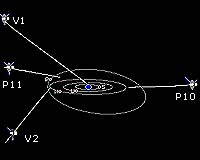
based on Heaven's Above Data
based on Heaven's Above Data |
It is the only spacecraft to have made measurements in the solar wind from such a great distance from the source of the dynamic solar environment. To commemorate this achievement, a public lecture will be held at the Smithsonian Air & Space Museum in Washington, DC on November 5 at 8:00PM. For more details, go here:
Recent observations indicate that Voyager 1 is in a region unlike any encounter in its 26 years of exploration. These observations and what they may infer about the approach to the termination shock will be the subject of a NASA Space Science Update (SSU) on November 5, 2003. The SSU will be carried live on NASA Select beginning at 1:00 PM EST.
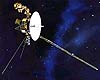
The Voyager mission, now in its 27th year, continues its quest to push the bounds of space exploration. The twin Voyager 1 and 2 spacecraft opened new vistas in space by greatly expanding our knowledge of Jupiter and Saturn. Voyager 2 then extended the planetary adventure when it flew by Uranus and Neptune, becoming the only spacecraft ever to visit these worlds.
Voyager 1, now the most distant human-made object in the universe, and Voyager 2, close on its heels, continue their ground-breaking journey with their current mission to study the region in space where the Sun's influence ends and the dark recesses of interstellar space begin.
Related Links
 Doing Maintenance Work Seven Billion Miles From The Office
 Pasadena - Apr 09, 2002