 |
 |
 |
 |
 |
 |
 |
 |
 |
 |

| . |  |
. |
NASA Researchers Studying Tropical Cyclones
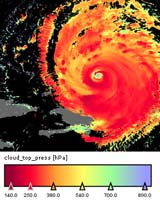
NASA hurricane researchers are deploying to Costa Rica next month to investigate the birthplace of eastern Pacific tropical cyclones. They will be searching for clues that could lead to a greater understanding and better predictability of one of the world�s most significant weather events � the hurricane. As scientists and coastal residents brace for another potentially challenging hurricane season, NASA is launching the Tropical Cloud Systems and Processes (TCSP) mission. TCSP is a month-long research effort primarily intended to document "cyclogenesis," the birth of tropical storms, hurricanes and related phenomena. Researchers will monitor oceanic thunderstorms to study why some systems develop into tropical cyclones and some do not. Researchers feel the data is vital to understanding how such weather systems evolve and travel. The data also could support development of a more accurate and timely warning system to help safeguard property and lives. A team of atmospheric scientists, engineers and aircraft personnel will take up residence in San Jose, Costa Rica during July. The NASA team will work with the National Oceanic and Atmospheric Administration (NOAA) and Costa Rican Centro Nacional de Alta Tecnologia (CENAT). The team will conduct ground-based and airborne studies to measure the buildup and behavior of tropical storm systems on Costa Rica's east and west coasts. Missions will be flown over the region using NASA's ER-2 and NOAA's WP-3D Orion aircraft and with unmanned aerial vehicles (aerosondes). The unmanned flights will be managed in conjunction with the University of Colorado at Boulder. The airborne experiments will collect temperature, humidity, precipitation, and wind information related to tropical cyclones and other phenomena that often lead to development of more powerful storms at sea. The field operations will also take advantage of several NASA and NOAA satellites. NASA and the Instituto Meteorologico Nacional of Costa Rica also will launch a series of RS-92 series, balloon-borne probes (sondes), to measure humidity and other data related to tropical storm origins. "Costa Rica is an ideal location for this research," said Dr. Ramesh Kakar, Weather Focus Area leader for NASA's Science Mission Directorate. A vast number of tropical storms and hurricanes impacting the eastern Pacific are spawned near the small Central American nation's western coast. "In the Atlantic, cyclogenesis often occurs off the western coast of Africa, or sufficiently far out over the ocean that long-duration science flights are extremely difficult," Kakar said. "In the eastern Pacific near Costa Rica, however, it is possible to study the genesis process from formation of the initial disturbance until, in some cases, it grows into a hurricane over a more compact geographical region." Researchers also will be able to take advantage of their proximity to the Caribbean and the western Gulf of Mexico, studying tropical systems off Costa Rica's eastern shores during more mature phases of development. "This experiment is significant for two reasons," said Robbie Hood, an atmospheric scientist at the Marshall Space Flight Center, Huntsville, Ala. She is one of three lead scientists for the project in Costa Rica. "We will have an opportunity to take a closer look at the factors contributing to the initiation and intensification of tropical cyclones which are still somewhat mysterious processes for researchers and operational forecasters. We will also be examining what are the best combinations of satellite and aircraft technologies to improve how hurricanes are monitored and predicted," she said. "Building on a quarter century of ever improving spaceborne observations of the Earth, we are entering an exciting new era. It will be using information collected by satellites and uninhabited aerial vehicles to the best advantage for improved weather prediction and other societal benefits," Hood said. The new study continues NASA's successful Convection and Moisture Experiment (CAMEX) research series, conducted from 1998 to 2001 with NOAA. TCSP participants include NOAA's Hurricane Research Division, five NASA centers, 10 American universities and partner agencies in Costa Rica. For more information about TCSP on the Web Related Links Tropical Cloud Systems and Processes AOML TerraDaily Search TerraDaily Subscribe To TerraDaily Express  France Releases New Heatwave Plan As Temperatures Rise
 Paris (AFP) Jun 22, 2005
France was on a heatwave alert Wednesday as the government released its new emergency plan to avoid a repeat of the nearly 15,000 deaths attributed to the scorching temperatures of summer 2003. |
|
|
| The content herein, unless otherwise known to be public domain, are Copyright 1995-2016 - Space Media Network. All websites are published in Australia and are solely subject to Australian law and governed by Fair Use principals for news reporting and research purposes. AFP, UPI and IANS news wire stories are copyright Agence France-Presse, United Press International and Indo-Asia News Service. ESA news reports are copyright European Space Agency. All NASA sourced material is public domain. Additional copyrights may apply in whole or part to other bona fide parties. Advertising does not imply endorsement, agreement or approval of any opinions, statements or information provided by Space Media Network on any Web page published or hosted by Space Media Network. Privacy Statement All images and articles appearing on Space Media Network have been edited or digitally altered in some way. Any requests to remove copyright material will be acted upon in a timely and appropriate manner. Any attempt to extort money from Space Media Network will be ignored and reported to Australian Law Enforcement Agencies as a potential case of financial fraud involving the use of a telephonic carriage device or postal service. |