 |
 |
 |
 |
 |
 |
 |
 |
 |
 |

| . |  |
. |
Chinese prime minister starts two-day visit to Germany
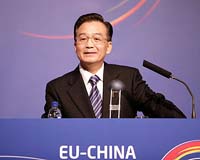
Hamburg, Germany, Sept 13, 2006 Chinese Premier Wen Jiabao arrived in Germany on Wednesday on a two-day visit expected to be dominated by talks on trade and the Iranian nuclear crisis. German Economy Minister Michael Glos urged Wen to open Chinese markets further and to clamp down on product piracy at an economic forum called China meets Europe in the northern port city of Hamburg, which is home to 700 companies that trade with China. "It is our shared aim to eradicate remaining problem areas on piracy," Gloss said, adding that Germany also wanted more Chinese investment to even out a trade balance weighted in Beijing's favour. On Thursday, Wen is due to hold talks with Chancellor Angela Merkel and President Horst Koehler. Merkel and Wen will discuss important international issues, including the situation in the Middle East and efforts to bring Iran to suspend sensitive nuclear work, government spokesman Ulrich Wilhelm said. China, a veto-wielding permanent member of the UN Security Council, is being pressed to support a threat of United Nations sanctions after Iran failed to meet a deadline of August 31 to stop uranium enrichment. The process yields material for atom bombs and has heightened fears that the Islamic Republic is trying to build a nuclear arsenal. Merkel has been trying to convince China to match its economic might with a greater diplomatic role in international affairs, notably on Iran. Human rights groups have urged Merkel to challenge Wen on human rights issues, as the chancellor claims she did in talks with the prime minister during a visit to China in May. Wen arrived in Germany from Britain where he oversaw the signing of key business agreements. Related Links Learn about nuclear weapons doctrine and defense at SpaceWar.com  Booming India, China to underpin Asian growth: IMF
 Singapore, Sept 14, 2006
 Asia is set for another year of robust growth as the twin engines of China and India drive the emerging economies and Japan extends a recovery from its long slump, the IMF said Thursday. Emerging Asia will see growth of 8.3 percent this year and 8.2 percent in 2007, after 8.5 percent in 2005, the International Monetary Fund said in its twice-yearly World Economic Outlook report. |
|
|

| The content herein, unless otherwise known to be public domain, are Copyright 1995-2006 - SpaceDaily.AFP and UPI Wire Stories are copyright Agence France-Presse and United Press International. ESA PortalReports are copyright European Space Agency. All NASA sourced material is public domain. Additionalcopyrights may apply in whole or part to other bona fide parties. Advertising does not imply endorsement,agreement or approval of any opinions, statements or information provided by SpaceDaily on any Web page published or hosted by SpaceDaily. Privacy Statement |