 |
 |
 |
 |
 |
 |
 |
 |
 |
 |

| . |  |
. |
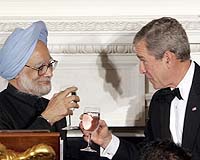
Bush, Singh discuss US-India nuke pact
Crawford, Texas (AFP) Aug 14, 2007 US President George W. Bush and Indian Prime Minister Manmohan Singh on Tuesday discussed the controversial US-India civilian nuclear energy agreement, the White House said. Their telephone conversation came as US officials look for ways to overcome stiff opposition in India and in the US Congress to the pact, which the embattled Bush sees as a key foreign policy victory. "What I would point out to you is that the president and Prime Minister Singh have been very supportive of it, as it is debated there in India" after being concluded last month, said Bush spokeswoman Dana Perino. "We'll see if we can get you some more, in terms of how we can support Prime Minister Singh. The civil nuclear agreement has many wonderful aspects to it, one of them being bringing India into the system of some monitoring and compliance," she added. The accord, which covers civil nuclear technology and seeks to bring India into the loop of global atomic commerce after a gap of three decades, was rejected almost immediately by the opposition and Singh's communist allies. "You have a country that has explosive population that very much needs access to clean-burning electricity, of which nuclear power certainly would be," Perino told reporters while Bush was on his Texas ranch. "And that would help raise economic levels across the country, help create jobs, as well as make sure that people aren't suffering from the ill effects that you can get from traditional energy uses like coal, that can harm people's health," she said. "And nuclear power, obviously, doesn't have greenhouse gases, which can contribute to helping us reach the goals that the president has set for reducing greenhouse gas emissions," said Perino. The spokeswoman noted that Bush had invited major global polluters, including China and India, to Washington for a September 27-28 conference on curbing greenhouse gas emissions. The deal clinched in Washington last month allows India to buy civilian nuclear technology while possessing nuclear weapons, making it an exception under the Nuclear Non-Proliferation Treaty. One of the trickiest issues -- whether India's unilateral decision to test nuclear weapons would end the deal -- appeared to have been sidestepped. The deal must also be approved by the US Congress and other nations under the umbrella of the Nuclear Suppliers Group. Bush also congratulated Singh and India on the 60th anniversary of its independence, and the two also discussed efforts to restart stalled global trade talks, as well as regional security issues, said Perino. Community Email This Article Comment On This Article Related Links Civil Nuclear Energy Science, Technology and News Powering The World in the 21st Century at Energy-Daily.com
 Damage at quake-hit Japanese power plant 'less than expected'
 Vienna (AFP) Aug 14, 2007
Damage at the world's largest nuclear plant in Japan, which was hit by a powerful earthquake last month, appears less than expected, the UN nuclear watchdog said Tuesday. |
|
|

| The content herein, unless otherwise known to be public domain, are Copyright 1995-2007 - SpaceDaily.AFP and UPI Wire Stories are copyright Agence France-Presse and United Press International. ESA Portal Reports are copyright European Space Agency. All NASA sourced material is public domain. Additional copyrights may apply in whole or part to other bona fide parties. Advertising does not imply endorsement,agreement or approval of any opinions, statements or information provided by SpaceDaily on any Web page published or hosted by SpaceDaily. Privacy Statement |