
 |
 |
 |
 |
 |
 |
 |
 |
 |
 |

| . |  |
. |
30 years after Three Mile Island, US eyes nuclear rebirth
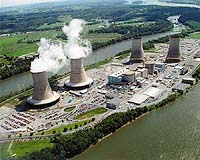
Washington (AFP) March 27, 2009 Thirty years after the accident at Three Mile Island shattered Americans' trust in nuclear power, lawmakers are touting a nuclear rebirth as a safe, green way to wean the United States off foreign oil. "We have the enormously powerful opportunity for a nuclear renaissance in our country. We need to pursue that aggressively and effectively to meet all of our energy and environmental goals," Senator David Vitter told a hearing of the Senate subcommittee on clean air and nuclear safety this week. No new reactors have been opened in the United States since the accident at Three Mile Island in central Pennsylvania, which began to unfold in the early hours of March 28, 1979 when cooling water started seeping through an open valve in a reactor. The technical glitch was compounded by human error, eventually leading to a partial meltdown of the reactor's core, making Three Mile Island the worst accident in US nuclear power industry. No one died in the accident and official reports commissioned by the Nuclear Regulatory Commission and US government agencies concluded that the escaping radiation had little impact on public health -- arguments that are still put forward today as calls crescendo for a nuclear renaissance. "We cannot run this machine called America without a nuclear component," said Senator James Inhofe, echoing a call made by Energy Secretary Steven Chu for nuclear power to be part of the US energy mix, along with clean technologies, to break the US addiction to foreign oil and fight climate change. According to the Nuclear Energy Institute, for nuclear power to even maintain its current 20-percent share of US power generation, three reactors would have to be built every two years starting in 2016. Seventeen industry groups have applied for licenses for more than 30 nuclear power plants, NEI said. Federal government loans are crucial to building those plants, which cost around six to eight billion dollars (4.4 to six billion euros) each. But the administration of President Barack Obama stripped 50 billion dollars of loan guarantees for the nuclear industry from the stimulus package in February, leaving just 18.5 billion dollars available. "It's a pretty shaky renaissance if no one is willing to pay for it," said Peter Bradford, a commissioner for the Nuclear Regulatory Commission at the time of Three Mile Island and now a university professor and board member of the Union of Concerned Scientists. Bradford drew historical parallels between the burgeoning nuclear industry of the 1970s and the proposed renaissance of the 2000s to highlight why he questions lawmakers' gung-ho drive for a nuclear revival. Just prior to Three Mile Island, the price of oil reached 40 dollars a barrel, which would be the equivalent of 115 dollars a barrel in today's money, he said. At the time, the cost of building a nuclear power plant was rising steadily and eventually surpassed the cost of other energy sources, he said. "Congress felt that we had to build more nuclear plants anyway because that was the only way to reduce our oil dependence," Bradford said. "We didn't build a lot more nuclear plants and we did get dependence down," largely thanks to larger than expected reserves of natural gas and improved energy efficiency, he said. "I'm very skeptical of the wisdom of designating nuclear power as a key part of the response to climate change and then lavishing millions of dollars on the industry ... especially given the other demands on the federal budget." Steve Wing, a professor at the University of North Carolina-Chapel Hill school of public health, said it would be irresponsible to increase nuclear power capacity without addressing the issue of how to dispose of nuclear waste. Obama's budget ruled out a proposed national repository at Nevada's Yucca Mountain, but, Wing argued, the United States would have faced "a tremendous problem with the transportation of waste across thousands of miles of public roads and railroads if it had opened." Wing also questioned the official line that the accident at Three Mile Island had a negligible impact on the health of nearby residents. A study led by Wing, which hypothesized that radioactive plumes from the accident would have been carried by the wind to nearby communities, found that the rates of lung cancer and leukemia in downwind areas were up to 30 times higher than in upwind areas. "I have problems with a nuclear renaissance," Wing said. "There are better alternatives." Share This Article With Planet Earth
Related Links Nuclear Power News - Nuclear Science, Nuclear Technology Powering The World in the 21st Century at Energy-Daily.com
 Vote on IAEA chief inconclusive after first three rounds
 Vienna (AFP) March 26, 2009
The race for the top job at the UN atomic agency remained open after the first three rounds of voting Thursday, with neither of the two candidates able to secure a convincing lead. |
|
|

| The content herein, unless otherwise known to be public domain, are Copyright 1995-2007 - SpaceDaily.AFP and UPI Wire Stories are copyright Agence France-Presse and United Press International. ESA Portal Reports are copyright European Space Agency. All NASA sourced material is public domain. Additional copyrights may apply in whole or part to other bona fide parties. Advertising does not imply endorsement,agreement or approval of any opinions, statements or information provided by SpaceDaily on any Web page published or hosted by SpaceDaily. Privacy Statement |
 del.icio.us
 Digg
Digg Reddit
 YahooMyWeb
 Google
 Facebook