|
 |
 |
 |
 |
 |
 |
 |
 |
 |

| . |  |
. |
ATV Starts Journey To Kourou
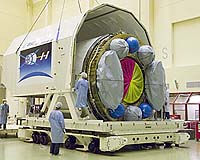
Noordwijk, Netherlands (ESA) Jul 16, 2007 Jules Verne, the first Automated Transfer Vehicle, will this evening leave ESA's research and technology centre, ESTEC, in Noordwijk, the Netherlands - for the start of a long journey to Kourou. Just ten days after the completion of final integration and space environment tests at the ESTEC test facilities, Jules Verne is now packed up and ready to leave on the first leg of the journey to Europe's Spaceport, in Kourou, French Guiana. The Automated Transfer Vehicle (ATV), 20 tonnes and the size of a London double-decker bus, is the largest spacecraft ever built in Europe. The unmanned vehicle will be used to ferry cargo to the International Space Station (ISS) and to raise its orbit.
Mind boggling For the past 10 weeks a specialised team has prepared a total of around 400 tonnes equipment for shipment across the Atlantic Ocean. Each item individually documented and then carefully packed into one of around 50 shipping containers, most of which have already been dispatched by truck to Rotterdam harbour. With the amount of parts, apparatus and tools accompanying Jules Verne to Kourou - if laid out on the ground, the cargo would cover a total area of some 1500 m2 - the logistics involved are mind boggling. "One of the major issues has been getting the customs paperwork in order," explains Stefan Brosze, ATV Transportation Manager. "There are members of our team who know exactly where to find everything, right down to the very smallest items."
Rotterdam harbour Tonight's operation sees the departure of the main spacecraft sections which are packed inside three large white containers. At around 21:30 CEST, a convoy of vehicles will leave ESTEC, travelling just 5 km to a nearby harbour. The journey continues the next day onboard two canal barges, finally arriving in Rotterdam harbour on Sunday. Jules Verne is scheduled to set sail from Rotterdam next Tuesday onboard the French cargo ship MN Toucan, a vessel which is normally used by Arianespace to transport Ariane rocket components on the same route across the Atlantic Ocean. Some eleven days later, MN Toucan arrives at Pariacabo harbour in Kourou. From there the ship's cargo is transferred by road to Europe's Spaceport. "Our job is not finished until we have delivered everything to the S5 Building without one single scratch," says Brosze. "Only then will we crack open the champagne!" Community Email This Article Comment On This Article Related Links Automated Transfer Vehicle Europe's Spaceport Rocket Science News at Space-Travel.Com
 Boeing To Bid For Ares I Instrument Unit Avionics Contract
 St. Louis MO (SPX) Jul 16, 2007
Decades of successful spaceflight and aircraft avionics integration and a highly experienced network of suppliers are the key to the Boeing bid to provide a low-risk approach to producing Instrument Unit Avionics (IUA) for the next-generation Ares I crew launch vehicle. |
|
|

| The content herein, unless otherwise known to be public domain, are Copyright 1995-2007 - SpaceDaily.AFP and UPI Wire Stories are copyright Agence France-Presse and United Press International. ESA Portal Reports are copyright European Space Agency. All NASA sourced material is public domain. Additional copyrights may apply in whole or part to other bona fide parties. Advertising does not imply endorsement,agreement or approval of any opinions, statements or information provided by SpaceDaily on any Web page published or hosted by SpaceDaily. Privacy Statement |