|
 |
 |
 |
 |
 |
 |
 |
 |
 |

| . |  |
. |
A Backward Sunspot Near The End Of Solar Cycle 23
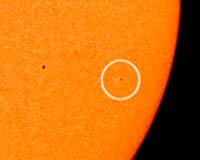
for NASA Science News Huntsville AL (SPX) Aug 16, 2006 On July 31st, a tiny sunspot was born. It popped up from the sun's interior, floated around a bit, and vanished again in a few hours. On the sun this sort of thing happens all the time and, ordinarily, it wouldn't be worth mentioning. But this sunspot was special: It was backward. "We've been waiting for this," says David Hathaway, a solar physicist at the Marshall Space Flight in Huntsville, Alabama. "A backward sunspot is a sign that the next solar cycle is beginning." "Backward" means magnetically backward. Hathaway explains: Sunspots are planet-sized magnets created by the sun's inner magnetic dynamo. Like all magnets in the Universe, sunspots have north (N) and south (S) magnetic poles. The sunspot of July 31st popped up at solar longitude 65 degrees W, latitude 13 degrees S. Sunspots in that area are normally oriented N-S. The newcomer, however, was S-N, opposite the norm. A picture is worth a 1000 words. In the magnetic map of the sun, below, N is white and S is black. The backward sunspot is circled: This tiny spot of backwardness matters because of what it might foretell: A really big solar cycle. Solar activity rises and falls in 11-year cycles, swinging back and forth between times of quiet and storminess. Right now the sun is quiet. "We're near the end of Solar Cycle 23, which peaked way back in 2001," explains Hathaway. The next cycle, Solar Cycle 24, should begin "any time now," returning the sun to a stormy state. Satellite operators and NASA mission planners are bracing for this next solar cycle because it is expected to be exceptionally stormy, perhaps the stormiest in decades. Sunspots and solar flares will return in abundance, producing bright auroras on Earth and dangerous proton storms in space: full story. But when will Solar Cycle 24 begin? "Maybe it already did--on July 31st," says Hathaway. The first spot of a new solar cycle is always backwards. Solar physicists have long known that sunspot magnetic fields reverse polarity from cycle to cycle. N-S becomes S-N and vice versa. "The backward sunspot may be the first sunspot of Cycle 24." It sounds exciting, but Hathaway is cautious on several fronts: First, the sunspot lasted only three hours. Typically, sunspots last days, weeks or even months. Three hours is fleeting in the extreme. "It came and went so fast, it was not given an official sunspot number," says Hathaway. The astronomers who number sunspots didn't think it worthy! Second, the latitude of the spot is suspicious. New-cycle sunspots almost always pop up at mid-latitudes, around 30 degrees N or 30 degrees S. The backward sunspot popped up at 13 degrees S. "That's strange." These odd-isms stop Hathaway short of declaring the onset of a new solar cycle. "But it looks promising," he says. Even if Cycle 24 has truly begun, "don't expect any great storms right away." Solar cycles last 11 years and take time to build up to fever pitch. For a while, perhaps one or two years, Cycle 23 and Cycle 24 will actually share the sun, making it a hodgepodge of backward and forward spots. Eventually, Cycle 24 will take over completely; then the fireworks will really begin. Meanwhile, Hathaway plans to keep an eye out for more backward sunspots. Related Links Stellar Chemistry, The Universe And All Within It  NASA Selects Radiation Belt Mission Candidate For Further Study
 San Antonio TX (SPX) Aug 03, 2006
An instrument developed by Los Alamos National Laboratory and the Southwest Research Institute is part of a proposal selected as a candidate to study the Earth's space weather from a pair of orbiting satellites. |
|
|

| The content herein, unless otherwise known to be public domain, are Copyright 1995-2006 - SpaceDaily.AFP and UPI Wire Stories are copyright Agence France-Presse and United Press International. ESA PortalReports are copyright European Space Agency. All NASA sourced material is public domain. Additionalcopyrights may apply in whole or part to other bona fide parties. Advertising does not imply endorsement,agreement or approval of any opinions, statements or information provided by SpaceDaily on any Web page published or hosted by SpaceDaily. Privacy Statement |