
 |
 |
 |
 |
 |
 |
 |
 |
 |
 |

| . |  |
. |
A Brief Mystery: What Are Short Gamma-Ray Bursts
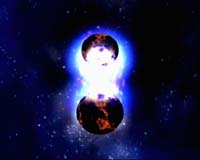
Science@NASA Huntsville AL (SPX) Oct 21, 2008 For decades it was baffling. Out of the still night sky, astronomers peering through their telescopes would occasionally glimpse quick bursts of high-energy light popping off like flashbulbs at the far side of the universe. These bursts seemed impossibly powerful: to appear so bright from so very far away, they must vastly outshine entire galaxies containing hundreds of billions of stars. These explosions, called gamma ray bursts (GRBs), are by far the brightest and most energetic phenomena in the known universe, second only to the Big Bang itself. Scientists were at a loss to imagine what could possibly cause them. Astronomers now know what the longer-lasting GRBs are: the collapse and explosion of an ultra-massive star to form a black hole at its core, an explanation first proposed by Stan Woosley of the University of California in San Diego. But there's a second category of GRBs that still remains a mystery. "The short-lived ones are very poorly understood. It's where the frontier [of research] is now," says Neil Gehrels, principal investigator for the GRB-detecting Swift satellite at NASA's Goddard Space Flight Center. Gehrels and other researchers have gathered this week at the Sixth Huntsville Gamma Ray Burst Symposium in Huntsville, Ala., to discuss progress on this and other mysteries surrounding GRBs. "We have had good evidence since the 1990s that the short bursts and long bursts were different classes," Gehrels explains. "It had to do with their gamma ray properties." Not only do the short bursts last less than about 2 seconds, the spectrum of light they emit is distinct. Gamma rays from short bursts lean toward the high-energy end of the spectrum, while long GRBs emit lower-energy gamma rays. The differences were highlighted in 2005 when, for the first time, telescopes caught sight of short GRB afterglows. The fading debris contained no supernova, arguing against the collapse of a massive star. George Ricker of MIT, principal investigator of NASA's HETE (High Energy and Transient Explorer) satellite, famously likened a short burst on July 9, 2005, to "the dog that didn't bark." Ultimately, the cause of short bursts is unknown. But scientists do have some good guesses. The leading theory is that these bursts are extremely violent collisions between pairs of neutron stars. These stars aren't gassy, wispy giants like other stars - a neutron star is more like an atomic nucleus that's 12 kilometers across. Since the atoms that make up normal, "solid" matter are mostly empty space, a star made almost entirely of tightly packed neutrons is extraordinarily dense: a fingernail's worth of a neutron star would have a mass of more than a trillion kilograms. A neutron star's density and gravity is second only to a black hole. "When you have these two hard stars that run into each other, it's a very rapid fiery explosion. It's kind of like a crash." So how could scientists know whether this explanation is true? One way could be to detect gravitational waves. Before the two neutron stars collide, they would orbit each other as a binary system. Because their fields of gravity are so intense, the stars ought to send waves rippling outward in the fabric of space-time: gravitational waves. As the neutron stars spiral in toward each other, the frequency of those waves would ramp up in a characteristic pattern called a chirp signal. "Scientists are trying to [detect] that now," Gehrels says. "It's the ultimate way of verifying the model." Scientists at the Huntsville symposium are discussing the progress of gravitational wave detectors such as the Laser Interferometer Gravitational-wave Observatory (LIGO) located in Hanford, Washington, and Livingston, Louisiana. By using lasers to carefully measure the distances between pairs of mirrors at these observatories, LIGO scientists can notice tiny changes in these distances that would occur if subtle gravitational waves were passing through the Earth. Other possible explanations for short GRBs exist as well, but only hard data from experiments such as LIGO can settle what is the real cause of these mysterious celestial bursts. Community Email This Article Comment On This Article Share This Article With Planet Earth
Related Links Science@NASA 6th Huntsville Gamma-ray Burst Symposium 2008 Stellar Chemistry, The Universe And All Within It
 NASA's Fermi Telescope Discovers First Gamma-Ray-Only Pulsar
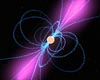 Washington DC (SPX) Oct 17, 2008
About three times a second, a 10,000-year-old stellar corpse sweeps a beam of gamma-rays toward Earth. Discovered by NASA's Fermi Gamma-ray Space Telescope, the object, called a pulsar, is the first one known that only "blinks" in gamma rays. |
|
|

| The content herein, unless otherwise known to be public domain, are Copyright 1995-2007 - SpaceDaily.AFP and UPI Wire Stories are copyright Agence France-Presse and United Press International. ESA Portal Reports are copyright European Space Agency. All NASA sourced material is public domain. Additional copyrights may apply in whole or part to other bona fide parties. Advertising does not imply endorsement,agreement or approval of any opinions, statements or information provided by SpaceDaily on any Web page published or hosted by SpaceDaily. Privacy Statement |
 del.icio.us
 Digg
Digg Reddit
 YahooMyWeb
 Google
 Facebook