
 |
 |
 |
 |
 |
 |
 |
 |
 |
 |

| . |  |
. |
A Bright Future For Plastics
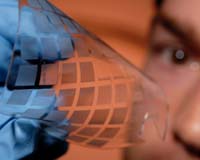
Washington DC (SPX) Jul 17, 2008 WITH market analysts predicting a ten fold increase in the value of the organic light emitting display industry, from 1.5 billion pounds to 15.5 billion pounds, by 2014, it is no wonder that scientists and governments alike are keen to advance research into "plastic electronics". July's edition of Physics World includes an in-depth feature by three Israeli researchers, Marianna Khorzov and David Andelman, from the School of Physics and Astronomy at Tel Aviv University, and Rafi Shikler, from the Electrical and Computer Engineering Department at Ben Gurion University, about exciting developments in the field. For a long time, plastic was thought of as an insulating material that could not conduct electricity, but ground-breaking research in the 1970s proved that some plastics could do so. Now, more than thirty years later some of the potential applications of these breakthrough materials - electronic billboards, flexible laptops, high-definition television screens only one centimetre thick - are coming to light. Plastic-based transistors and organic light-emitting displays are set to shake the electronics market. Transistors, the fundamental building block in modern electronic devices, are traditionally made of silicon. Plastic-based transistors however are easier and cheaper to manufacture than their silicon equivalent. And because plastic is flexible, we could soon see ultrathin, flexible laptops, for example, that would be impossible to make from silicon. Conventional light-emitting displays, used in televisions, iPods and digital watches, are rigid, expensive and complex to manufacture. Organic light-emitting displays, based on plastic electronics engineering, are easier to manufacture, more flexible and, as an added bonus, also consume less energy. This is why Sony, Samsung and Kodak are all devoting time and money to developing them. Other exciting developments are likely to be in the field of bionics, including the development of materials sensitive but flexible enough to replicate skin, which could be used by robots in situations where a sense of touch is crucial. The researchers write, "We expect that, for many applications, these materials will gradually replace silicon and metals, and they may even make possible entirely new technologies, particularly in the field of bionics, which seeks to link up technology with biological systems." Also in this issue: The future of quantum information science. Anton Zeilinger and Markus Aspelmeyer explain how recent technological advances are helping researchers solve some of the fundamental puzzles that quantum theory throws up. Symmetry and the world around us - could a bizarre 248D symmetry group really help us towards a theory of everything? Community Email This Article Comment On This Article Share This Article With Planet Earth
Related Links Institute of Physics Powering The World in the 21st Century at Energy-Daily.com
 SKorean fusion reactor takes step forward: scientists
 Seoul (AFP) July 15, 2008
Scientists at a South Korean experimental fusion reactor said Tuesday they had made a significant step forward in global efforts to produce clean and unlimited energy. |
|
|

| The content herein, unless otherwise known to be public domain, are Copyright 1995-2007 - SpaceDaily.AFP and UPI Wire Stories are copyright Agence France-Presse and United Press International. ESA Portal Reports are copyright European Space Agency. All NASA sourced material is public domain. Additional copyrights may apply in whole or part to other bona fide parties. Advertising does not imply endorsement,agreement or approval of any opinions, statements or information provided by SpaceDaily on any Web page published or hosted by SpaceDaily. Privacy Statement |
 del.icio.us
 Digg
Digg Reddit
 YahooMyWeb
 Google
 Facebook