. Earth Science News .
A Fantastic Monday Morning Sky Show

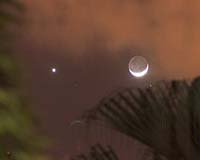
Venus and the crescent Moon. Photo credit: Zhen Jie of Singapore. July 17, 2007.
by Dr. Tony Phillips for NASA Science News
Huntsville AL (SPX) Nov 05, 2007
This is worth waking up for. On Monday morning, Nov. 5th, anyone willing to step outside before dawn will see a fantastic display of stars and planets-and maybe a couple of spaceships, too.

The planets: Venus, Saturn and Mars
Venus is the extravagantly luminous "star" hanging low in the east. You can't miss it-especially because the crescent Moon is hanging nearby. The closely-spaced pair is as lovely as anything you will ever see in the heavens.

If you can, tear your eyes away from Venus and the Moon. Just above them hangs Saturn, a delicate yellow beauty that cries out for the attention of your telescope; even small 'scopes reveal Saturn's breathtaking rings. And above Saturn, almost directly overhead, shines Mars. It is bright, distinctly orange, and for reasons science cannot fully explain, a little hypnotic.

The stars: Too many to name!
You won't be the only one looking at the planets. Orion the Hunter is there, too, outlined in the sky by an hour-glass of first and second magnitude stars. Joining Orion is Castor, Pollux, Regulus, Aldebaran and brightest of all, Sirius, the blue-white Dog Star: sky map This stellar sprawl frames the planets in a scene guaranteed to spellbind-that is, until something comes along to break the spell.

That would be the spaceships: Space shuttle Discovery and the International Space Station (ISS)
The two orbiters are due to fly over many US towns and cities on Monday morning. If things go according to plan, Discovery will undock from the ISS at 5:32 am EST (updates), which means the two ships will appear as distinct points of bright light, side-by-side, gliding together past Mars, Sirius, Orion, Venus and the Moon. Check NASA's Skywatch web site for spotting times.

What comes next may strain the credulity of some readers, but it is true. In addition to the stars, planets, spaceships and lunar close encounters, there is also an exploding comet:

Comet 17P/Holmes burst into view last week when something happened to the comet's core-a collapse, a fracture, a comet-quake? No one knows!-causing the comet to surge in brightness almost a million-fold. It is now visible to the unaided eye as an expanding fuzzball in the constellation Perseus similar in brightness to the stars of the Big Dipper. To find the comet, first face Mars and then spin around 180-degrees: sky map. It's a must-see target for backyard telescopes.

Nov. 5th: Set your alarm!

Community
Email This Article
Comment On This Article

Related Links
Astronomy News from Skynightly.com


Memory Foam Mattress Review
Newsletters :: SpaceDaily :: SpaceWar :: TerraDaily :: Energy Daily
XML Feeds :: Space News :: Earth News :: War News :: Solar Energy News


Sky-Map Site To Show The Beauty Of The Universe To Everybody
Washington DC (SPX) Feb 01, 2007
Technological progress has altered many of the ways in which humans live, but has done little to change human beings themselves. Man has been trying to find his place in the world for thousands of years. We are still eager to understand our role in the universe and the universe itself. That is why it is hard enough to find a person who would stay indifferent or apathetic to the questions of cosmology.


  • Hungry Mexico flood victims turn to looting
  • Northrop Grumman Wins Two Contracts For AN/APN-241 Radar Program
  • Triage Study Challenges Notions of Emergency Medical Response To Disaster
  • New Computer Architecture Aids Emergency Response

  • Drought in southeast US fuels battle over water resources
  • Climate controversy heats up Australian election
  • Like It Or Not, Uncertainty And Climate Change Go Hand-In-Hand
  • White House defends 'health benefits' of climate change

  • NASA Data May Help Improve Estimates Of A Hurricane's Punch
  • DMCii Satellite Imaging Helps Dramatically Reduce Deforestation Of Amazon Basin
  • NASA Views Southern California Fires And Winds
  • A Roadmap For Calibration And Validation

  • PetroChina to debut Monday in Shanghai
  • Industry welcomes fuel price hikes in China, but tensions remain
  • CSIRO And Queensland Government To Workshop Smart Exploration Techniques
  • Green500 List To Put Supercomputing On A Diet

  • Deadly HIV-TB co-epidemic sweeps sub-Saharan Africa: report
  • Northwestern Exposing Most Deadly Infectious Diseases In 3D
  • Staph-Killing Properties Of Clay Investigated
  • AIDS stunting southern Africa's prospects: Malawi president

  • Divers Find New Species In Aleutians
  • Flying Lemurs Are The Closest Relatives Of Primates
  • Could Hairy Roots Become Biofactories
  • Dead Clams Tell Many Tales

  • Cairo tries to escape life under a black cloud
  • Massive pollution in Yangtze river can be reversed: scientists
  • US Faces Burning Emissions Issue
  • Birth defects soar in polluted China

  • Research Project May Revolutionize Apparel Industry
  • World Toilet Summit opens in India
  • Europeans face mob anger over child 'abductions' in Chad
  • India's toilet champion sees human liberation in loos for all

  • The content herein, unless otherwise known to be public domain, are Copyright 1995-2007 - SpaceDaily.AFP and UPI Wire Stories are copyright Agence France-Presse and United Press International. ESA Portal Reports are copyright European Space Agency. All NASA sourced material is public domain. Additional copyrights may apply in whole or part to other bona fide parties. Advertising does not imply endorsement,agreement or approval of any opinions, statements or information provided by SpaceDaily on any Web page published or hosted by SpaceDaily. Privacy Statement