 |
 |
 |
 |
 |
 |
 |
 |
 |
 |

| . |  |
. |
A Growing Edge To Russian Military Sales Part Two
Washington (UPI) Dec 17, 2007 Russia's ability to sell vast quantities of tough, durable, modern weapons systems to nations around the world is rooted in the military experience and consequent design experience of its arms industry -- one very different from that of the United States. For decades, U.S. military supremacy in war, as well as its prosperous and remarkably growing dynamic economy and society in peacetime, has been based on the principle of cutting-edge technology and innovation. This was how the United States in the past quarter century was able to dramatically outpace Japan and Germany in applying the lessons of the information technology revolution from communications to iPods and personal computers. This philosophy has served the United States well in its wars, too. The Union Army during the Civil War pioneered the use of railroad logistics, supply and rapid transportation of larger military forces. Even then, U.S. use of air power in the forms of observation balloons and sea power in terms of pioneering ironclad, armored, powered warships was remarkably innovative and years, sometimes decades, ahead of European practice. By contrast, Russia was the world's dominant land continental power for hundreds of years, dominating vast tracts of both Europe and Asia, and repeatedly forced to fight for its very survival in long, bloody land wars involving hundreds of thousands, and eventually millions of troops on both sides. Russia was a predominantly command economy with the state directing and controlling the lion's share of resources even under the czars and even then, military power and overwhelming superiority in numbers of troops and weapons over neighbors was the primary concern of the state. This tendency only intensified under the Soviet system after the 1917 communist revolution. The Soviet Union won its 1941-45 Great Patriotic War against Nazi Germany -- the longest, bloodiest and most intense single military conflict in recorded history -- in large part because it was able to manufacture enormous numbers of extremely cheap, mass-produced, durable weapons systems that were simple but highly effective and easily replaced. The U.S. achievement in producing enormous numbers of weapons -- especially combat bombers, fighters, transport aircraft, trucks, heavy artillery and warships during World War II -- was even more impressive than the Soviet Union's. Nevertheless, the motivating traditions that came out of the U.S. World War II experience were very different: In large part because of the outstanding achievements of such aircraft as the Boeing B-29 Superfortress strategic bomber and the North American P-51 Mustang air superiority combat fighter, and the remarkable achievement of designing and constructing the world's first atomic bombs, the United States came out of the war with conviction that cutting-edge superiority in advanced technology was the dominant factor in building weapons systems to assure America's security and dominant global position. The trauma caused by the sensational series of Soviet space firsts from the first artificial satellite Sputnik 1 launched in October 1957 to Col. Yury Gagarin's achievement as the first man in space and the first human to orbit the Earth in April 1961 intensified this American obsession on regaining and maintaining high-tech dominance. It led directly to the creation in 1958 of the Defense Advanced Research Projects Agency, and it has served the American public and economy as well as the U.S. military exceptionally well over the past six decades. But the fact remains that this fundamental difference in design philosophy underlies why the Russian arms industry, while decade behind the United States in many advanced technology areas, still manages to perform so well today. (Next: Where the Russian advantage works) Community Email This Article Comment On This Article Related Links The Military Industrial Complex at SpaceWar.com Learn about the Superpowers of the 21st Century at SpaceWar.com
 Greece Set To Buy Up Big With Russian Military Sales
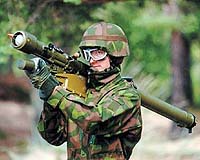 Moscow (UPI) Dec 17, 2007
 The Athens authorities have decided to buy 415 BMP-3 infantry fighting vehicles from Russia. (United Press International's "Outside View" commentaries are written by outside contributors who specialize in a variety of important issues. The views expressed do not necessarily reflect those of United Press International. In the interests of creating an open forum, original submissions are invited.) |
|
|

| The content herein, unless otherwise known to be public domain, are Copyright 1995-2007 - SpaceDaily.AFP and UPI Wire Stories are copyright Agence France-Presse and United Press International. ESA Portal Reports are copyright European Space Agency. All NASA sourced material is public domain. Additional copyrights may apply in whole or part to other bona fide parties. Advertising does not imply endorsement,agreement or approval of any opinions, statements or information provided by SpaceDaily on any Web page published or hosted by SpaceDaily. Privacy Statement |