|
 |
 |
 |
 |
 |
 |
 |
 |
 |

| . |  |
. |
A Little Bit Of Progress At The Space Station
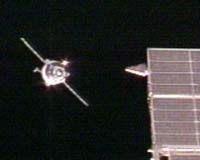
Houston TX (SPX) Apr 27, 2006 The Russian Progress cargo carrier docked at the International Space Station at 1:41 p.m. Eastern Time Wednesday. The 21st Progress to visit the station delivered 5,040 pounds of equipment and supplies. Included in its cargo are more than 1,900 pounds of propellant, just over 100 pounds of air and oxygen, 661 pounds of water and almost 2,360 pounds of dry cargo. The new Progress also has on board some small crustaceans for a Russian scientific experiment called Aquarium. That experiment looks at stability of closed ecological systems in microgravity. It could provide information useful for lengthy human spaceflights. Progress 21 docked at the aft port of the Zvezda Service Module. Station crewmembers, Expedition 13 commander Pavel Vinogradov and NASA science officer Jeff Williams were scheduled to open the Progress hatch later in the day and begin unloading on Thursday. Progress 20, the sister cargo carrier and predecessor at the station, will remain at the Pirs Docking Compartment until mid-June, after which the crew will fill it with trash and surplus equipment, and undock it. Ground controllers will de-orbit the craft and burn it up in Earth's atmosphere. Progress 21 launched from the Baikonur Cosmodrome in Kazakhstan on Monday at 10:03 p.m. local time. The Russian rocket also carried the first of three small, spherical satellites developed at the Massachusetts Institute of Technology. Called SPHERES - for Synchronized Position Hold Engage Re-orient Experimental Satellites - the mini-satellites are about the size of volleyballs. They are designed to float weightless in space while maintaining a precise position. Their designers think such instruments could serve as parts of a massive telescope looking for planets near other stars. The station crew will conduct the first critical test of SPHERES on May 18 inside the facility. Then, two of the mini-sats will be set adrift and observed to see if they can maintain their positions within one centimeter. "We're doing this because these missions have a lot of new, untried technology," said research team member David W. Miller at MIT. "Testing inside the space station will allow us to mature these technologies in a less risky micro-gravity environment," meaning inside the warm, air-filled station, rather than outside in the hazardous conditions of space." Eventually, the mini-sats will be tested in formation and in orbit, maintaining their positions via radio links, and interacting almost constantly to stay where they belong in relation to one another. The idea is the array will behave like a huge multiple-mirror telescope, with each element's position adjusted frequently to keep the overall instrument properly focused. The research team envisions using advanced versions of SPHERES as robots that can work together on construction projects, repair damage, refuel other satellites or work as parts of other systems - including telescopes of unprecedented size. Two additional SPHERES are scheduled to reach the space station later this year aboard the space shuttle. Related Links ISS  Progress 21 Heads For Space Station
 Houston TX (SPX) Apr 25, 2006
Roscosmos launched a pilotless Progress spacecraft toward a Wednesday rendezvous with the International Space Station. |
|
|

| The content herein, unless otherwise known to be public domain, are Copyright 1995-2006 - SpaceDaily.AFP and UPI Wire Stories are copyright Agence France-Presse and United Press International. ESA PortalReports are copyright European Space Agency. All NASA sourced material is public domain. Additionalcopyrights may apply in whole or part to other bona fide parties. Advertising does not imply endorsement,agreement or approval of any opinions, statements or information provided by SpaceDaily on any Web page published or hosted by SpaceDaily. Privacy Statement |