
 |
 |
 |
 |
 |
 |
 |
 |
 |
 |

| . |  |
. |
A Look Into The Nanoscale
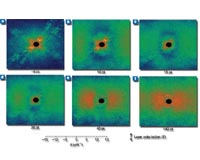
Livermore CA (SPX) Jul 03, 2008 Lawrence Livermore National Laboratory researchers have captured time-series snapshots of a solid as it evolves on the ultra-fast timescale. Using femtosecond X-ray free electron laser (FEL) pulses, the team, led by Anton Barty, is able to observe condensed phase dynamics such as crack formation, phase separation, rapid fluctuations in the liquid state or in biologically relevant environments. Other Livermore scientists include Michael Bogan, Stafan Hau-Riege, Stefano Marchesini, Matthias Frank, Bruce Woods, former Livermore researcher Sa"a Bajt and former LLNL scientist Henry Chapman, who is now at the Centre for Free Electron Laser Science, DESY, in Hamburg, Germany. "The ability to take images in a single shot is the key to studying non-repetitive behavior mechanisms in a sample," Barty said. As the femtosecond laser blasts the sample, it is destroyed, but not before the scientists created images with a 50-nanometer spatial resolution, and a 10-femtosecond shutter speed. (A femtosecond is one billionth of one millionth of a second. For context, a femtosecond is to a second as a second is to about 32 million years.) "This experiment opens the door to a new regime of time-resolved experiments in mesoscopic dynamics," Barty said. "This technique could be extended to a few nanometers spatial and a few tens of femtoseconds temporal resolution." This is the first time that optical pulses have been used to image samples at the nanometer-spatial resolution scale. Earlier studies were limited to a few micrometers. The "shutter speed" of the measurements is determined by the femtosecond duration of the FEL X-ray pulse. This allowed the team to obtain nanometer spatial resolution of violent and destructive events in which the sample is completely destroyed. The new technique is necessary to study ultrafast dynamics of non crystalline materials at nanometer-length scales. This includes fracture dynamics, shock formation, spallation, ablation and plasma formation under extreme conditions. The technique also allows researchers to image dynamic process in the solid state such as nucleation and phase growth, phase fluctuations and various forms of electronic or magnetic segregation. Community Email This Article Comment On This Article Share This Article With Planet Earth
Related Links Lawrence Livermore National Laboratory Nano Technology News From SpaceMart.com Computer Chip Architecture, Technology and Manufacture
 On the Boil: New Nano Technique Significantly Boosts Boiling Efficiency
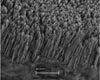 Troy NY (SPX) Jul 03, 2008
Whoever penned the old adage "a watched pot never boils" surely never tried to heat up water in a pot lined with copper nanorods. |
|
|

| The content herein, unless otherwise known to be public domain, are Copyright 1995-2007 - SpaceDaily.AFP and UPI Wire Stories are copyright Agence France-Presse and United Press International. ESA Portal Reports are copyright European Space Agency. All NASA sourced material is public domain. Additional copyrights may apply in whole or part to other bona fide parties. Advertising does not imply endorsement,agreement or approval of any opinions, statements or information provided by SpaceDaily on any Web page published or hosted by SpaceDaily. Privacy Statement |
 del.icio.us
 Digg
Digg Reddit
 YahooMyWeb
 Google
 Facebook