. Earth Science News .
A Pocket Of Near-Perfection

more images

Huntsville - Apr 27, 2004
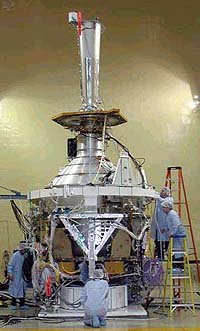
Engineers don't often indulge in poetic flourish when discussing the things they build. So when words like "beautiful" and "elegant" and "artful" frequently cross the lips of scientists and engineers as they talk about the design of Gravity Probe B (GP-B), one might suspect that this spacecraft is truly something special.

The probe, which launched April 20th on a mission to test an unproven aspect of Einstein's theory of relativity, is by all accounts a marvel of human ingenuity and know-how. Only recently has it even become technologically possible to build Gravity Probe B, despite the fact that the idea for the experiment has been around since the 1950s.

"If experimental science is an art, then I would look at GP-B as a Renaissance masterpiece," says Jeff Kolodziejczak, NASA's Project Scientist for GP-B at the Marshall Space Flight Center.

The beauty of GP-B's design lies in part in its ability to create, in the messy real world, a pocket of near-perfection. The goal of the experiment demands it. Researchers hope to detect a bending of spacetime around Earth so subtle that even a minute interference from some outside force or a tiny internal imperfection in the spacecraft itself would mask the effect they're hunting for.

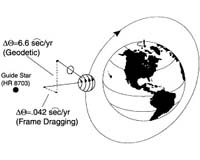
Einstein's theory of General Relativity predicts that Earth, by rotating, twists space and time around with it, forming a mild vortex in the fabric of spacetime around our planet. Researchers call this "frame dragging." Most physicists believe the spacetime vortex is real, but no experiment to date has been sensitive enough to detect it unequivocally.


Related Links
Gravity Probe B
SpaceDaily
Search SpaceDaily
Subscribe To SpaceDaily Express

Embedded Memory About To Get A Boost With MRAM
Palo Alto CA - Apr 27, 2004
The launch of the sophisticated magnetic random-access memory (MRAM) technology is expected to revolutionize the embedded memory market. It combines the high storage and low cost of dynamic RAM (DRAM), high speed of static RAM (SRAM) and the non-volatility of flash memory to provide a single and unified memory solution.


  • Satellites Act As Thermometers In Space
  • Moss Landing Researchers Reveal Iron As Key To Climate Change
  • Forecasters Can Count Lightning Strikes to Estimate Rainfall
  • Scientists "Reconstruct" Earth's Climate Over Past Millennia

  • Keeping An Eye On Central America
  • Arctic Ozone Loss More Sensitive To Climate Change Than Thought
  • Earth Search Sciences' Technology Benefits Noranda
  • MDA To Build DigitalGlobe's Next-Generation Satellite Image Processor

  • An 'Off The Wall' Idea
  • Renewable Energy Promotes US Job Growth Better Than Fossil Fuels
  • Hybrid Vehicles To Race Ahead Of Battery And Fuel Cell Versions
  • Department of Energy To Revisit Cold Fusion


  • Customer Takes Control Of Thuraya
  • Boeing to Ship NASA's Tracking and Data Relay Satellite to Florida for March Launch
  • Eutelsat Boosts Hispasat Stake To 27 Percent
  • Intelsat Secures Launch Services For Intelsat X Series Satellites


  • The content herein, unless otherwise known to be public domain, are Copyright 1995-2006 - SpaceDaily.AFP and UPI Wire Stories are copyright Agence France-Presse and United Press International. ESA PortalReports are copyright European Space Agency. All NASA sourced material is public domain. Additionalcopyrights may apply in whole or part to other bona fide parties. Advertising does not imply endorsement,agreement or approval of any opinions, statements or information provided by SpaceDaily on any Web page published or hosted by SpaceDaily. Privacy Statement