
 |
 |
 |
 |
 |
 |
 |
 |
 |
 |

| . |  |
. |
A Pool Of Distant Galaxies
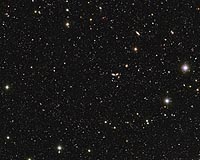
Paris, France (SPX) Nov 10, 2008 Anyone who has wondered what it might be like to dive into a pool of millions of distant galaxies of different shapes and colours, will enjoy the latest image released by ESO. Obtained in part with the Very Large Telescope, the image is the deepest ground-based U-band image of the Universe ever obtained. It contains more than 27 million pixels and is the result of 55 hours of observations with the VIMOS instrument. This uniquely beautiful patchwork image, with its myriad of brightly coloured galaxies, shows the Chandra Deep Field South (CDF-S), arguably the most observed and best studied region in the entire sky. The CDF-S is one of the two regions selected as part of the Great Observatories Origins Deep Survey (GOODS), an effort of the worldwide astronomical community that unites the deepest observations from ground- and space-based facilities at all wavelengths from X-ray to radio. Its primary purpose is to provide astronomers with the most sensitive census of the distant Universe to assist in their study of the formation and evolution of galaxies. The new image released by ESO combines data obtained with the VIMOS instrument in the U- and R-bands, as well as data obtained in the B-band with the Wide-Field Imager (WFI) attached to the 2.2 m MPG/ESO telescope at La Silla, in the framework of the GABODS survey. The newly released U-band image - the result of 40 hours of staring at the same region of the sky and just made ready by the GOODS team - is the deepest image ever taken from the ground in this wavelength domain. At these depths, the sky is almost completely covered by galaxies, each one, like our own galaxy, the Milky Way, home of hundreds of billions of stars. Galaxies were detected that are a billion times fainter than the unaided eye can see and over a range of colours not directly observable by the eye. This deep image has been essential to the discovery of a large number of new galaxies that are so far away that they are seen as they were when the Universe was only 2 billion years old. In this sea of galaxies - or island universes as they are sometimes called - only a very few stars belonging to the Milky Way are seen. One of them is so close that it moves very fast on the sky. This "high proper motion star" is visible to the left of the second brightest star in the image. It appears as a funny elongated rainbow because the star moved while the data were being taken in the different filters over several years. Share This Article With Planet Earth
Related Links ESO Astronomy News from Skynightly.com
 Fingers, Loops And Bays In The Crab Nebula
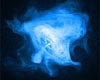 Boston MA (SPX) Nov 06, 2008
This image gives the first clear view of the faint boundary of the Crab Nebula's X-ray-emitting pulsar wind nebula. The nebula is powered by a rapidly-rotating, highly-magnetized neutron star, or "pulsar" (white dot near the center). |
|
|

| The content herein, unless otherwise known to be public domain, are Copyright 1995-2007 - SpaceDaily.AFP and UPI Wire Stories are copyright Agence France-Presse and United Press International. ESA Portal Reports are copyright European Space Agency. All NASA sourced material is public domain. Additional copyrights may apply in whole or part to other bona fide parties. Advertising does not imply endorsement,agreement or approval of any opinions, statements or information provided by SpaceDaily on any Web page published or hosted by SpaceDaily. Privacy Statement |
 del.icio.us
 Digg
Digg Reddit
 YahooMyWeb
 Google
 Facebook