|
 |
 |
 |
 |
 |
 |
 |
 |
 |

| . |  |
. |
A Robot Invention With A Leg To Stand On
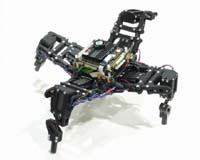
Washington (AFP) Nov 17, 2006 A US scientist has created a robot that can find a way to keep working on its own after suffering damage, an invention that could prove useful for robotic space missions in distant planets, according to a study. Joshua Bongard, a University of Vermont engineer whose research article appeared in Friday's Science Magazine, pulled off one of a homemade robot's four legs for his experiment. The robot was programmed to assess the damage by moving in playful-looking sequences allowing it to find the problem, Bongard said. Once the damage was identified, the robot created a new way to move without the missing limb, allowing it to continue its mission. "There is a need for planetary robotic rovers to be able to fix things on their own," Bongard said in a statement. "The research is essential for NASA who plan to continue using robots for planetary missions. Robots on other planets must be able to continue their mission without human intervention in the event they are damaged and cannot communicate their problem back to Earth," he said. Bongard conducted the research for the National Aeronautics and Space Administration (NASA) and the US Department of Energy.
Source: Agence France-Presse Related Links University of Vermont All about the robots on Earth and beyond!  Making Robotic Movement Of Goods More 'Pallet-Able'
 Charlotte NC (SPX) Nov 13, 2006
Robots running amok and destroying property may be a staple in science fiction films, but they aren't welcome in factories, warehouses and other places where automatic guided vehicle (AGV) forklifts are used. Under a cooperative research and development agreement with Transbotics, a Charlotte, N.C., AGV manufacturer, the National Institute of Standards and Technology (NIST) is developing advanced sensor processing and modeling algorithms to help robot forklifts verify the location and orientation of pallets laden with goods. |
|
|

| The content herein, unless otherwise known to be public domain, are Copyright 1995-2006 - SpaceDaily.AFP and UPI Wire Stories are copyright Agence France-Presse and United Press International. ESA PortalReports are copyright European Space Agency. All NASA sourced material is public domain. Additionalcopyrights may apply in whole or part to other bona fide parties. Advertising does not imply endorsement,agreement or approval of any opinions, statements or information provided by SpaceDaily on any Web page published or hosted by SpaceDaily. Privacy Statement |