|
 |
 |
 |
 |
 |
 |
 |
 |
 |

| . |  |
. |
A SWIRE Picture Is Worth Billions Of Years
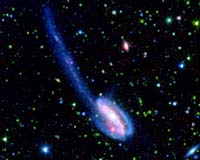
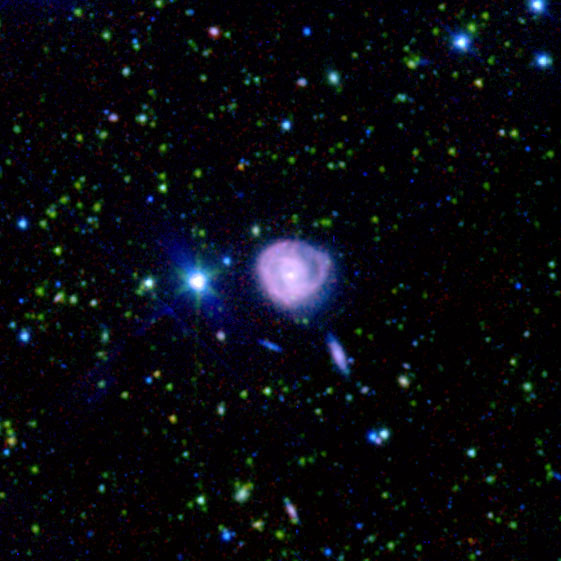
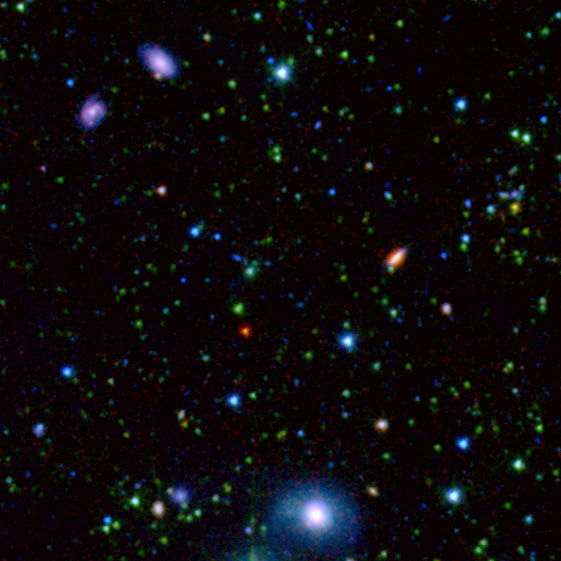
Pasadena CA (JPL) Oct 28, 2005 These spectacular images, taken by the Spitzer Wide-area Infrared Extragalactic (SWIRE) Legacy project, encapsulate one of the primary objectives of the Spitzer mission: to connect the evolution of galaxies from the distant, or early, universe to the nearby, or present day, universe. The Tadpole galaxy (shown) is the result of a recent galactic interaction in the local universe. Although these galactic mergers are rare in the universe's recent history, astronomers believe that they were much more common in the early universe. Thus, SWIRE team members will use this detailed image of the Tadpole galaxy to help understand the nature of the "faint red-orange specks" of the early universe. The larger picture (figure 2) depicts one-sixteenth of the SWIRE survey field called ELAIS-N1. In this image, the bright blue sources are hot stars in our own Milky Way, which range anywhere from 3 to 60 times the mass of our Sun. The fainter green spots are cooler stars and galaxies beyond the Milky Way whose light is dominated by older stellar populations. The red dots are dusty galaxies that are undergoing intense star formation. The faintest specks of red-orange are galaxies billions of light-years away in the distant universe. Figure 3 features an unusual ring-like galaxy called CGCG 275-022. The red spiral arms indicate that this galaxy is very dusty and perhaps undergoing intense star formation. The star-forming activity could have been initiated by a near head-on collision with another galaxy. The most distant galaxies that SWIRE is able to detect are revealed in a zoom of deep space (figure 4). The colors in this feature represent the same objects as those in the larger field image of ELAIS-N1. The observed SWIRE fields were chosen on the basis of being "empty" or as free as possible from the obscuring dust, gas, and stars of our own Milky Way. Because Earth is located within the Milky Way galaxy, there is always a screen of Milky Way objects blocking our view of the rest of the universe. In some places, our view of the larger universe is less obscured than others and for the most part is considered "empty." These are prime observing spots for astronomers interested in studying objects beyond the Milky Way. ELAIS-N1 is only one of six SWIRE survey fields. The full survey covers 49 square degrees of the sky, equivalent to the area covered by about 250 full moons. The SWIRE images are 3-channel false-color composites, where blue represents visible green light (light that would appear to be blue/green to the human eye), green captures infrared light of 3.6 microns, and red represents infrared emissions of 8 microns. The infrared data are from Spitzer's infrared array camera and the visible-light data are from the Isaac Newton Telescope, Spain. Related Links SpaceDaily Search SpaceDaily Subscribe To SpaceDaily Express  Integral: Three Years Of Insight Into The Violent Cosmos
 Paris (ESA) Oct 18, 2005
Observing the cosmos, full of violent phenomena and extreme energy, has been the task of ESA's Integral gamma-ray observatory since its launch on 17 October 2002. Three years later, the mission is going very well and has recorded a wealth of important discoveries. |
|
|

| The content herein, unless otherwise known to be public domain, are Copyright 1995-2006 - SpaceDaily.AFP and UPI Wire Stories are copyright Agence France-Presse and United Press International. ESA PortalReports are copyright European Space Agency. All NASA sourced material is public domain. Additionalcopyrights may apply in whole or part to other bona fide parties. Advertising does not imply endorsement,agreement or approval of any opinions, statements or information provided by SpaceDaily on any Web page published or hosted by SpaceDaily. Privacy Statement |