
 |
 |
 |
 |
 |
 |
 |
 |
 |
 |

| . |  |
. |
A Station Celebration
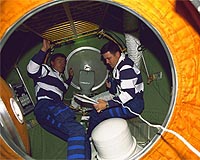
Cape Canaveral FL (SPX) Dec 05, 2008 Ten years ago on December 4, 2008, NASA and its partner nations began building a dream: the International Space Station. On that date, space shuttle Endeavour lifted off on its 12-day mission to deliver NASA's Unity module and connect it to Russia's Zarya control module already orbiting Earth. The commander of that first space shuttle construction flight to the station was astronaut Bob Cabana - now director of NASA's Kennedy Space Center in Florida. Cabana recalls vividly that first trip to the fledgling station, when he and Russian cosmonaut Sergei Krikalev prepared to be the first crew members to enter the newly joined modules. "We finally got all the hatches open and we're up to the main hatch going into Node 1 (Unity). We open the hatch and Sergei Krikalev was with me. I just waved my hand toward the hatch and the two of us entered together," says Cabana. "I think what it talks about on the space station is international cooperation. You know, there wasn't a first person in. It was we went in together." Despite his unique place in space station history, it is the sense of international cooperation that continues to impress Cabana. "When you look at Japan, Canada, the European space agency and all its partners, Russia. You take all those different cultures, people and hardware built around the world and it comes together for the first time on orbit and it works flawlessly - that's phenomenal," he says. "The engineering of it is phenomenal. But when you throw in the cultural differences and that we have worked together in space as partners through some tough times and some easier times for 10 years now - that's amazing." As the station's construction nears completion, Cabana reflects on the continuing work aboard the station. "Right now, 24 hours a day seven days a week, 365 days a year, we have humans in space exploring - exploring how to work in that microgravity environment in space. In that harsh environment where it can be as cold as minus 150 F or as hot as 300 degrees," he explains. "We're making things work. We're doing real science. We're going to do more science when we get a larger crew up there. We're proving the systems that we need. We have an excellent international cooperative partnership." Cabana concludes, "I think folks need to know that we can work together. That it's not just when the shuttle launches. There's a crew up there right now doing real work in space. " Share This Article With Planet Earth
Related Links Q and A with Bob Cabana Station at NASA Station and More at Roscosmos S.P. Korolev RSC Energia Watch NASA TV via Space.TV Space Station News at Space-Travel.Com
 NASA Signs Modification To Contract With Russian Space Agency
 Moscow (RIA Novosti) Dec 04, 2008
NASA has signed a $141 million modification to the current International Space Station (ISS) contract with the Russian space agency for crew transportation services planned through the spring of 2012. |
|
|

| The content herein, unless otherwise known to be public domain, are Copyright 1995-2007 - SpaceDaily.AFP and UPI Wire Stories are copyright Agence France-Presse and United Press International. ESA Portal Reports are copyright European Space Agency. All NASA sourced material is public domain. Additional copyrights may apply in whole or part to other bona fide parties. Advertising does not imply endorsement,agreement or approval of any opinions, statements or information provided by SpaceDaily on any Web page published or hosted by SpaceDaily. Privacy Statement |
 del.icio.us
 Digg
Digg Reddit
 YahooMyWeb
 Google
 Facebook