|
 |
 |
 |
 |
 |
 |
 |
 |
 |

| . |  |
. |
A Wet Past Launches Quest For Life On Red Planet
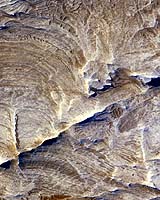
San Francisco (AFP) Feb 15, 2007 Growing evidence of water on Mars adds weight to the theory that life once existed and could still exist beneath its surface, said a group of scientists meeting in San Francisco. "We have abundant evidence that early Mars was water rich," Houston, Texas, Lunar and Planetary Institute astronomer Stephen Clifford told the annual meeting of the American Association for the Advancement of Science (AAAS). Although water is essential for life, its presence on Mars now or in the past does not necessarily point to life on the Red Planet, but it gives scientists who support the theory some ground for their arguments. Besides new geological evidence on the presence of water published Thursday in Science magazine, Clifford also mentioned features on Mars such as valleys, shorelines and sediments where lakes, seas or even oceans may have once flowed. Recent NASA images from Mars Reconnaissance Orbiter's (MRO) high-definition camera show layers of light- and dark-colored rocks around fractures inside a canyon, signs that water may have seeped to the surface hundreds of millions of years ago or longer. "On Earth, bleaching of rock surrounding a fracture is a clear indication of chemical interactions between fluids circulating within the fracture and the host rock," said University of Arizona astronomer and geologist Chris Okubo, co-author of the Science study. In a press conference with other Mars specialists, Okubo said the phenomenon could also indicate cyclical deposits from rain, wind or volcanic activity. The fractures between rocky layers themselves also provide good proof of underground water, which MRO and Europe's Mars Express radars should be able to detect, said Clifford. Recent observations have already provided signs that water might be present in the Martian subsoil. In December, the US Mars Global Surveyor beamed down photographs of two small gullies formed only a few years ago in a Martian crater that could point to water still percolating on the Martian surface. The surface of Mars is too cold for liquid water to exist, but scientists believe underground water filtered to the surface carrying debris downslope long enough to form the gullies before it froze. Since 2000, astronomers poring over Mars photographs have observed thousands of rivulets along crater walls that were possibly formed by either water or mud flows. Another indication that life might lurk under the Martian surface is the recent discovery of atmospheric methane, a gas chiefly produced by bacteria. Mars exploration strategy is currently focused on finding water or its tell-tale traces, but is should also look for the essential building blocks of life, said NASA Ames Research Center scientist Tori Hoeshsler. "We have evidence on Earth now there are organisms supported by the interaction of water and rock ... rocks releasing hydrogen, and understanding the interaction of water and rocks on Mars to provide energy is critical for search for life on Mars," he said. Only a multi-disciplined approach to Mars exploration, said the scientists, can provide definite proof of life past or present on Mars, which US President George W. Bush has set as the post-Moon target for a manned space mission.
Source: Agence France-Presse Email This Article
Related Links  San Francisco CA (SPX) Feb 20, 2007
Hunting for traces of life on Mars calls for two radically different strategies, says Arizona State University professor Jack Farmer. Of the two, he says, with today's exploration technology we can most easily look for evidence for past life, preserved as fossil "biosignatures" in old rocks. Farmer is a professor of geological sciences in ASU's School of Earth and Space Exploration, where he heads the astrobiology program. |
|
|

| The content herein, unless otherwise known to be public domain, are Copyright 1995-2006 - SpaceDaily.AFP and UPI Wire Stories are copyright Agence France-Presse and United Press International. ESA PortalReports are copyright European Space Agency. All NASA sourced material is public domain. Additionalcopyrights may apply in whole or part to other bona fide parties. Advertising does not imply endorsement,agreement or approval of any opinions, statements or information provided by SpaceDaily on any Web page published or hosted by SpaceDaily. Privacy Statement |