|
 |
 |
 |
 |
 |
 |
 |

| . |  |
. |

|
|
. |

 by Staff Writers London, UK (SPX) Jun 20, 2011
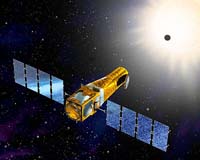
An exciting meeting yesterday, Wednesday 15 June 2011, held at the Institute of Physics (IOP) in partnership with the Royal Astronomical Society (RAS), saw leading experts explain how far the field of exoplanet detection has advanced since the first confirmed detection in the early '90s. Now that more than 550 exoplanets have been detected, and with increasingly frequent detections being announced by global teams working with space- and ground-based telescopes, the speakers explained how we have entered a golden age of discovery. Chaired by the President of IOP, Professor Dame Jocelyn Bell Burnell, the speakers - Professor Hugh Jones from the University of Hertfordshire, Dr Suzanne Aigrain from the University of Oxford and Dr Giovanna Tinetti from University College London - took the audience through the history of exoplanet detection, and explained the techniques being used to maximise our understanding of planets beyond our solar system. After Professor Jones' introduction to the field and Dr Aigrain's description of some of the methods used to map out and understand the full population of exoplanets in our galaxy, Professor Dame Jocelyn Bell Burnell remarked, "how exciting it is to think that there are probably more exoplanets than there are stars in our night sky." The field has progressed from early identification of gas giants, dubbed 'hot Jupiters', to slightly smaller but still uninhabitable 'Neptunes', and now 'super earths'; planets with a mass only five to ten times that of our Earth's. As researchers move ever closer to finding Earth-mass planets in the 'Goldilocks Zone' - realms of space the correct distance from stars for orbiting planets to be at a temperature that allows the existence of water and, possibly, harbours life - Dr Tinetti described the progress being made in techniques used to analyse environments on planets thousands of light years from Earth. Topics raised in the question and answer session which concluded the event included the parameters of inquiry used in the attempt to identify life-harbouring planets - from the strength of gravity to the stability of orbits - and, a bit closer to home, what efforts humankind makes to identify hazardous near-Earth objects, such as asteroids. The seminar was held hot on the heels of an announcement from CoRoT - a space telescope operated by the French space agency CNES which speaker Dr Suzanne Aigrain is involved with - about the discovery of ten new planets, including one orbiting a star possibly only a few hundred million years old, twin Neptune-sized planets, and a Saturn-like world. A report from the event is due out in the autumn. An introductory guide to exoplanets
|
. |
|
| The content herein, unless otherwise known to be public domain, are Copyright 1995-2011 - Space Media Network. AFP and UPI Wire Stories are copyright Agence France-Presse and United Press International. ESA Portal Reports are copyright European Space Agency. All NASA sourced material is public domain. Additional copyrights may apply in whole or part to other bona fide parties. Advertising does not imply endorsement,agreement or approval of any opinions, statements or information provided by Space Media Network on any Web page published or hosted by Space Media Network. Privacy Statement |
 del.icio.us
 Digg
Digg Reddit
 Google