 |
 |
 |
 |
 |
 |
 |
 |
 |
 |

| . |  |
. |
Actel's Space FPGAS Return To Mars
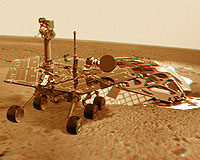
Mountain View, - Feb 11, 2004 In a stunning sequel to the 1997 Mars Pathfinder mission, Actel Corporation announced today that its radiationtolerant and radiation-hardened field-programmable gate arrays (FPGAs) have returned to Mars, playing critical roles throughout the missions, both American and European. From Delta launch vehicles to orbiting, landing and actively roving the surface of the planet, Actel has provided hundreds of FPGAs to enable implementation of various mission-critical digital logic functions, including power management, attitude and orbit control, command and data handling, and instrumentation and telemetry. The space-optimized FPGAs were chosen because of the inherent benefits of the company's nonvolatile products � proven reliability at extreme temperatures and live at power-up functionality all on a single chip, which reduces component count, thereby minimizing power consumption and saving board space and weight. "Since 1990, Actel's space FPGAs have been onboard more than 100 launches and accepted for flight-unit applications on more than 300 satellites. When the Mars Pathfinder Rover landed on Mars in 1997, it was Actel devices that helped to send back thousands of amazing photographs � a clear measure of the success of that mission," explained Barry Marsh, vice president, product marketing, Actel Corporation. "Today, Actel's devices continue to be ubiquitous in the exploration of space with hundreds of devices utilized for multiple Mars missions. We are pleased to reinforce our role as a critical player in the technology behind the major breakthrough occurring in space today and we will continue to design, test and develop cutting-edge products for use in space." The Actel radiation-tolerant and radiation-hardened devices provided critical functions on the Delta launch vehicles, which propelled the Spirit and Opportunity spacecrafts toward Mars. During the six-month flight from Earth to Mars, Actel's devices were employed on central system computers, performing navigation activities, including star tracking and sun sensing. On each of the Mars Explorer Rovers, Actel's space FPGAs are the "heart and soul" of the 10 cameras, which capture astounding images of the planet's surface. The devices also enable key radio communications, which relay those images back to the orbiters. Aboard the orbiters, the devices enable the relay stations, which transmit images and vital control information between Mars and Earth. Specifically, on the European Space Agency's Mars Express Orbiter, Actel's offerings are also being leveraged for many mission-critical functions, including the solid state recorders, which alone use more than 20 Actel FPGAs. Over the last decade, Actel FPGAs have been onboard more than 100 launches and flown on over 300 satellites, including Atlas II, Echostar, SBIRS-High, International Space Station, Mars Pathfinder, Mars Explorer Rovers 1 and 2, Mars Express Orbiter, Spirit and Opportunity Rovers, and the Hubble Space Telescope. Related Links Actel Corporation SpaceDaily Search SpaceDaily Subscribe To SpaceDaily Express  DuPont Products Go to Mars and Beyond
 Wilmington - Feb 11, 2004
Opportunity has landed. Since the birth of manned space flight more than four decades ago, DuPont has been along for the ride with products essential for lighter weight, reduced volume, durability and environmental resistance. Today's Mars Exploration Rovers - Spirit and Opportunity - are enabled by materials from DuPont Electronic Technologies. |
|
|

| The content herein, unless otherwise known to be public domain, are Copyright 1995-2006 - SpaceDaily.AFP and UPI Wire Stories are copyright Agence France-Presse and United Press International. ESA PortalReports are copyright European Space Agency. All NASA sourced material is public domain. Additionalcopyrights may apply in whole or part to other bona fide parties. Advertising does not imply endorsement,agreement or approval of any opinions, statements or information provided by SpaceDaily on any Web page published or hosted by SpaceDaily. Privacy Statement |