|
 |
 |
 |
 |
 |
 |
 |
 |
 |

| . |  |
. |
Aegis Missile Defense Fleet Tops 80 Ships
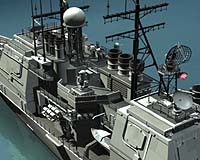
Moorestown NJ (SPX) Nov 28, 2006 Lockheed Martin delivered the 100th Aegis Weapon System to the U.S. Navy during a ceremony in which Chief of Naval Operations Adm. Mike Mullen announced that the destroyer receiving the system will be named Wayne E. Meyer, after the retired rear admiral who is widely regarded as the "Father of Aegis." "I can think of no better name for a new destroyer than Wayne E. Meyer, and no better tribute to the man who inspired and delivered Aegis to our fleet. He is a legend, a man of great vision and leadership," said U.S. Navy Chief of Naval Operations Adm. Mike Mullen. "That the ship bearing his name will also receive the 100th Aegis system seems proof enough that his legacy -- and the incredible combat system he made possible -- continue to serve us well in this long war. It is just as impossible to overstate the contributions of Aegis to our nation's defense as it is to imagine where our great Navy would be without the contributions of Adm. Meyer." Aegis is the most successful air defense weapon system and multi-mission combat system in the history of the U.S. Navy. Aegis delivered revolutionary capability to the fleet immediately upon its introduction in 1983 and the periodic delivery of progressive spiral development upgrades has since maintained the Aegis Weapon System at a state-of-the-art technology level to take on new, more complex threats. For example, Wayne E. Meyer (DDG-108)'s Aegis Weapon System has eight times more computing power and costs 66 percent less than the first Aegis baseline. "Lockheed Martin is the top high-tech employer in South Jersey, and the well being of the plant and its employees is a priority for me in Washington," said Rep. Jim Saxton, a senior member of the House Armed Services Committee. "But Congress and the nation also have security concerns that are international in scope, and our Navy is critical in projecting U.S. policy around the world. Aegis is the shield that protects our forces and allows us to do that." In addition to 13 U.S. Navy Aegis-equipped ships now under construction, the U.S. Navy is currently modernizing Aegis-equipped cruisers first delivered in the 1980s with Aegis Open Architecture (Aegis OA), which will add 20-25 years of front-line service. The first modernized cruiser with Aegis OA will be delivered in 2008. The ability to continuously evolve and improve the Aegis Weapon System is the cornerstone of Rear Adm. Wayne E. Meyer's legacy as the Navy's Aegis Program Manager beginning in the 1970s. Meyer introduced a systems engineering discipline into the program that focused on innovative integration and cost control, leading to an enduring principle that lives on today: "Build a little, test a little, learn a lot." "Our nation is so fortunate to have a visionary leader like Rear Adm. Meyer," said Fred Moosally, president of Lockheed Martin's Maritime Systems and Sensors business. "The world sees his systems engineering excellence in ships flying the flags of five nations, in ships that are setting the bar in ballistic missile defense, and in ships that will continue to be the most advanced multi-mission warships for decades." The Aegis Weapon System is the world's premier naval surface defense system and is the foundation for Aegis Ballistic Missile Defense, the primary component of the sea-based element of the United States' Ballistic Missile Defense System. Aegis seamlessly integrates the SPY-1 radar, the MK 41 Vertical Launching System, the Standard Missile family and the weapon system's command and control system. Related Links Lockheed Martin Learn about missile defense at SpaceWar.com  India Says First Missile Intercept Test A Success
 Bhubaneswar (AFP) India, Nov 27, 2006
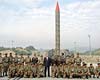
India said Monday that its first test of a missile designed to intercept other missiles was a success, amid its ongoing efforts to develop a home-grown ballistic interception system. The test saw a surface-to-surface Prithvi-II (earth) missile shot down over the Bay of Bengal by a similar missile fired seconds later. |
|
|

| The content herein, unless otherwise known to be public domain, are Copyright 1995-2006 - SpaceDaily.AFP and UPI Wire Stories are copyright Agence France-Presse and United Press International. ESA PortalReports are copyright European Space Agency. All NASA sourced material is public domain. Additionalcopyrights may apply in whole or part to other bona fide parties. Advertising does not imply endorsement,agreement or approval of any opinions, statements or information provided by SpaceDaily on any Web page published or hosted by SpaceDaily. Privacy Statement |