|
 |
 |
 |
 |
 |
 |
 |
 |
 |

| . |  |
. |
After 60 Days In Bed It Surely Is Time To Get Up
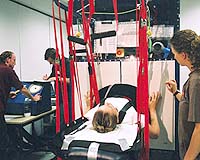
Noordwijk, Netherlands (SPX) Dec 08, 2005 The second round of the women 'bed rest' experiment being carried out by ESA and CNES has now been completed. The 12 volunteers are back on their feet again, after spending two whole months lying down. At the CNES Institute for Space Medicine and Physiology (MEDES) in Toulouse, this second group of 12 female European volunteers spent 60 days lying down on beds tilted at an angle of 6�, their heads positioned slightly lower than their feet. Lying in this position prompts over time certain physiological changes similar to those caused by extended periods of exposure to the weightless conditions of space. This bed rest campaign forms part of the Women International Space Simulation for Exploration study. The WISE 2005 study is being carried out jointly by the European Space Agency, the French space agency CNES, the Canadian Space Agency and NASA. It is needed in order to address gender-specific differences between male and female astronauts. The first group of 12 women underwent their 60-day stint in bed back in March-May. The female volunteers are subjected to certain conditions simulating those experienced by astronauts on long-duration space missions. Weightlessness eventually results in loss of muscle, fluid and bone mass. But this experiment is not specifically designed to study those phenomena. The real object of the exercise is to test measures that could be used to counter the adverse effects of weightlessness on astronauts and ascertain which ones are best for female crew members. The test subjects were therefore divided into three groups in order to try out different counter-measures: a control group, an exercise group taking physical exercise on apparatus adapted to a lying-down position and a nutrition group whose diet included protein supplements. To obtain statistically reliable results, an overall sample group of 24 was required, which is why this second set of 12 volunteers � comprising one Scot, one Swiss-German, three Fins and seven Frenchwomen � checked into the MEDES Space Clinic in September to take part in this second round.
Two identical sessions As Peter Jost, ESA project coordinator, explains: "One of the hardest challenges in conducting this experiment the second time round was to reproduce precisely the same procedures and the same experimentation, in order to end up with a coherent set of results." Arnaud Beck, medical coordinator of the MEDES-based simulation, adds: "We took great care to redo things exactly the same as the first time round, with the same people being assigned to the same tasks." The regime followed by this second group of a dozen volunteers was scrupulously identical to that of the first session. However, this time, an extra effort was made by the kitchen staff at the Rangueil Hospital in Toulouse to improve the quality of the meals, to make them more appetising, without altering their strictly-monitored nutritional content. Peter Jost explains: "To keep their bones healthy, the volunteers eat large amounts of fruit and vegetables. But we have to take account of their digestive capacity, which is reduced by stomach displacement in the ribcage in the bed rest position." Under these conditions, where meal intake in itself is a difficult exercise, it was vital to make things as agreeable as possible. Satisfying the volunteers' information needs was also handled a little differently this time round. An interpreter working full-time was on hand to assist the medical team, making it easier to deal with certain subtle cultural differences. The end result was a highly-motivated team of volunteers, well aware of the study's scientific importance and of the necessity of certain forms of experimentation - and certain restrictions too. During the two months, the 12 volunteers were far from idle. They were required to undergo regular medical checks, psychological monitoring and - in the case of the group of four testing the exercise counter-measure - do physical exercise. They were able to do language classes, and even drawing classes. They received various visits, including one from explorer St�phane L�vin, an expert in surviving extreme environmental conditions. They also met their counterparts from the first session, who were back in Toulouse for a series of follow-up checks, six months after their return to a normal daily routine.
Visiting astronauts Last week, two astronauts visited the volunteers to share some of their experiences of spaceflight with them. First came Italian Roberto Vittori, who has twice flown on Soyuz missions to the International Space Station and was in Toulouse for a conference on future missions to Mars. Three days later came Frenchman Michel Tognini, the Director of the European Astronaut Centre in Cologne, and veteran of two flights, one Soyuz mission to the Mir station and the other aboard Space Shuttle Columbia.

|