 |
 |
 |
 |
 |
 |
 |
 |
 |
 |

| . |  |
. |
After Shenzhou VI, China Sets Sights On Manned Space Station
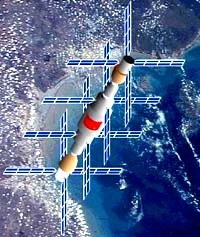
Beijing (AFP) Oct 17, 2005 After its most successful foray into space yet, China is preparing for its next major objective -- a space station giving the world's oldest civilization a permanent presence in orbit. The return to Earth early Monday of the Shenzhou VI with two astronauts on board marked the end of stage one in China's space odyssey, and while stage two will kick off in due course, the Chinese will be patient, said observers. "The Chinese are not in a hurry. This is going to be dictated by safety, by budget. It will be a very incremental program," said Joan Johnson-Freese, an expert on China's space program at the US Naval War College. Astronauts Fei Junlong and Nie Haisheng came back to a hero's welcome Monday after 115 hours and 32 minutes in orbit, traveling a lengthy 3.25 million kilometers (two million miles) through space. Just hours later, Tang Xianming, director of China Manned Space Engineering Office, told a press conference the next mission, including a space walk, was scheduled for around 2007. Docking operations, meaning hooking up two spacecraft in orbit, would take place in the period from 2009 to 2012, he said. All is seen as preparation for a space station, but significant technical challenges remain. Most important among these will be to develop a rocket that is powerful enough to make the nation's ambitions a reality, said James Oberg, a US-based aerospace consultant. China does have designs ready for such a rocket, dubbed the Long March 5, which will have three times the power of the current Long March 2F if eventually built, said Oberg, who previously worked in the US space program. "That would be the key to their space station, the key to profitable commercial launches of communications satellites, and the key, if they want to, to fly the Shenzhou farther from Earth," he said. "They could fly around the moon. I don't see them seriously interested in manned lunar landing. It's just vastly more expensive with only marginal more political benefits." A Long March 5 rocket is at least five years into the future, and it will bring new challenges once it is operational, as it will force China to build a new launch center. The rail leading to the existing Jiuquan Satellite Launch Center on the edge of the Gobi desert in northern China is simply not large enough. A likely alternative site is on Hainan island, the tropical province south of the mainland, which would allow the rockets to be transported by barge to the launch pad, said Oberg. Moving the launch site would do away with a cumbersome left-over from the era of Mao Zedong, founder of Communist China, according to analysts. The Jiuquan site first emerged in the early 1960s as a ballistic missile research and test center, intentionally located as far from China's international borders as possible. "Mao basically required them to be very inland for security purposes. So the locations of their launch sites are a cold war legacy," said Johnson-Freese. A less secretive location does not mean the space program will shed its partly military character. After the Shenzhou VI landed before daybreak in the Inner Mongolian grasslands, Chinese top legislator Wu Bangguo hailed its significance for "national defense capabilities," without elaborating. There is nothing surprising about this, according to analysts, who say virtually every space program in the world has potential military applications. "Of course, 95 percent of space technology is dual-use," said Johnson-Freese. "What's the difference between a rocket and a missile? They are both launchers. A satellite takes its image, and it can be used for either weather purposes, flood control or weapons targeting." The space program will also show the world that China is a force to be reckoned with, according to David Baker, a London-based space policy analyst for Jane's Defence Weekly. "The next great step is to really send that message throughout the whole world, which I don't think is really getting through to a lot of people in Europe and America, that China eventually this century is going to become the world's dominant economy," he said. Related Links SpaceDaily Search SpaceDaily Subscribe To SpaceDaily Express  Chinese Astronauts Return To Earth, New Mission In 2007
 Beijing (AFP) Oct 17, 2005
China's second manned space flight ended successfully Monday as the Shenzhou VI craft returned to Earth, leading to patriotic celebrations and plans for an ambitious new mission in 2007. |
|
|

| The content herein, unless otherwise known to be public domain, are Copyright 1995-2006 - SpaceDaily.AFP and UPI Wire Stories are copyright Agence France-Presse and United Press International. ESA PortalReports are copyright European Space Agency. All NASA sourced material is public domain. Additionalcopyrights may apply in whole or part to other bona fide parties. Advertising does not imply endorsement,agreement or approval of any opinions, statements or information provided by SpaceDaily on any Web page published or hosted by SpaceDaily. Privacy Statement |