|
 |
 |
 |
 |
 |
 |
 |
 |
 |

| . |  |
. |
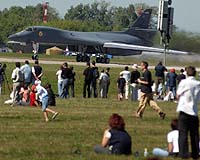
Air Force B-1B Lancer Takes To Russian Skies
Zhukovsky, Russia (SPX) Aug 19, 2005 The B-1B Lancer may have once been feared by the former Soviet Union during the Cold War because it could rapidly deliver massive quantities of weapons against any adversary in the world. Now the Air Force bomber again is making history, this time actually in the former Soviet Union at the Moscow International Air Show and Space Salon held Aug. 16-21 at Ramenskoye Airfield here. The backbone of America's long-range bomber force is conducting daily maneuvers through Russian skies at supersonic speed, and the aircraft and its advanced weapons system is being intercepted with excitement by both Americans and Russians alike. "It's an honor to fly the first B-1s into Russia," said Capt. Steve Jones, a B-1B pilot from Ellsworth Air Force Base, S.D. "We're all humbled that the Russians invited us to the air show and are allowing us to participate." Demonstrating the bomber's capabilities in front of a daily crowd of hundreds of thousands is a symbol of the friendship and international cooperation between the United States and its once-adversary, Jones said. "I think it shows how much progress our two nations have made since the Cold War," he said. "The fact the United States would bring one of its strategic bombers into this country and that the Russians will allow us to not only display the aircraft, but that we're able to fly it here ... it shows how diffused the whole Cold War has really become." The finality of the Cold War is even more apparent when you look at the static displays, Jones said. "We're parked approximately 300 feet from Russian weapons systems, some of which were designed primarily to shoot this aircraft down, and here we are parked right next to them at their air show," he said. "It's pretty cool." Both the aircraft and the U.S. military members are being well received, said Capt. Ryan Sweeney, weapons systems officer for the aircraft. "The Russians have been very accommodating and welcoming," he said. "After flying our profile here and landing, they thanked us for our demonstration. The mayor of Moscow also formally thanked us and presented us with a token of appreciation for our participation. It's obvious that they want us to feel welcome, and we definitely do." With the appreciation comes an inquisitiveness about the aircraft's strength, said Capt. David Black, 34th Aircraft Maintenance Unit officer in charge of overseeing the B-1B's maintenance. "With its capability to go more than 900 miles per hour, the Lancer is considered to be one of the premier fly over jets. It represents American horsepower and makes the most noise," Black said. "People seem to be very curious about it. They want us to tell them the difference between our aircraft and their bomber." Although the B-1B and its crew normally averages about 14 or 15 air shows a year, it doesn't make their participation in this year's Moscow show any less exciting, Black said. "We couldn't have been more warmly accepted," he noted. "It's just a great honor and it's amazing to be here in Russia. I didn't think we'd ever be doing this in our life time. The Lancer was initially developed in the 1970s as a replacement for the B-52, an aircraft designed to deliver nuclear bombs into the former Soviet Union during the Cold War. This is the second time the United States has displayed military aircraft at the air show; the first time was in 2003. In 2001 the Department of Defense participated with a technology booth. Other American aircraft showcased during the Moscow air show include the F-15E Strike Eagle, F-16C Fighting Falcon, KC-10 Extender, KC-135 Stratotanker.
Related Links  Moscow, Russia (SPX) Aug 18, 2005
EADS and Irkut have agreed to further strengthen their cooperation by signing important agreements at MAKS air show. |
|
|

| The content herein, unless otherwise known to be public domain, are Copyright 1995-2006 - SpaceDaily.AFP and UPI Wire Stories are copyright Agence France-Presse and United Press International. ESA PortalReports are copyright European Space Agency. All NASA sourced material is public domain. Additionalcopyrights may apply in whole or part to other bona fide parties. Advertising does not imply endorsement,agreement or approval of any opinions, statements or information provided by SpaceDaily on any Web page published or hosted by SpaceDaily. Privacy Statement |