|
 |
 |
 |
 |
 |
 |
 |
 |
 |

| . |  |
. |
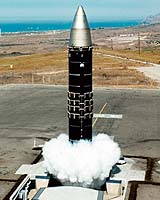
Air Force Says Farewell To Most Powerful ICBM
F.E. Warren AFB WY (AFPN) Sep 22, 2005 The era of the Peacekeeper intercontinental ballistic missile, often credited with helping end the Cold War, is coming to its own close Sept. 19 with the final phase of the deactivation process. The deactivation began in October 2002 after President Bush set a plan in motion in 2001 to reduce the country's missile forces from 6,000 to between 1,700 and 2,200. Russian President Vladimir Putin agreed to follow a similar plan. The Peacekeeper is the most powerful, accurate missile ever deployed, said Lt. Col. David Bliesner, 400th Missile Squadron commander here. Capable of carrying up to 10 independently targeted nuclear warheads, the Peacekeeper was designed to strengthen the ground-based strategic policy of the United States. The development of the missile system began in 1979. In 1988, the Peacekeeper became fully operational and 50 missiles were deployed here under operational control of the 400th MS. Each missile cost about $70 million. The deactivation is estimated to save the Air Force more than $600 million through 2010. "There are certainly conflicting emotions associated with deactivation of Peacekeeper and the 400th Missile Squadron," Colonel Bliesner said. "Thinking about it on a national and global level, anytime we can reduce the number of nuclear weapons in the world, it is certainly the best thing to do." Airmen with the 90th Missile Maintenance Group here spend about 17 days deactivating each missile, while security forces ensure the security of the removal. Senior Master Sgt. Steven Levin, the 90th Maintenance Operations Squadron training flight supervisor, has worked with the Peacekeeper since 1986 when he helped put up the first Peacekeeper site. Since then he has worked as a Peacekeeper guidance technician, team chief, quality assurance, and was most recently in charge of the Peacekeeper deactivation office which developed the Phase 1 deactivation plan in 2002. "When we brought it on line it was very exciting," Sergeant Levin said. "It has served its purpose and completed its mission." After the deactivation is complete, missileers with the 400th MS either will be retrained as Minuteman III crewmembers or reassigned to other parts of the Air Force. "There is a sense of nostalgia seeing something so powerful go away," said Capt. Carrie Owens, a 400th MS missileer. "We are all so proud of it." "We've spent a lot of our time (in the missile field)," said Capt. Lee Taylor, a 400th MS missileer. "There's a lot of pride that goes into this job." The final deactivation brings an end to more than 16 years of the Peacekeeper history here. "We're proud of what we've done," Sergeant Levin said. "It's time to move on. The mission is complete." The base is also home to the missile squadron that has operational control of 150 Minuteman III missiles. Related Links SpaceDaily Search SpaceDaily Subscribe To SpaceDaily Express  North Korea Renews Calls For US To Deliver Light-Water Reactors
 United Nations (AFP) Sep 22, 2005
North Korea on Thursday renewed its call on the United States to provide light-water reactors as soon as possible and said Pyongyang would have no need for nuclear weapons if its ties with Washington were normalized. |
|
|

| The content herein, unless otherwise known to be public domain, are Copyright 1995-2006 - SpaceDaily.AFP and UPI Wire Stories are copyright Agence France-Presse and United Press International. ESA PortalReports are copyright European Space Agency. All NASA sourced material is public domain. Additionalcopyrights may apply in whole or part to other bona fide parties. Advertising does not imply endorsement,agreement or approval of any opinions, statements or information provided by SpaceDaily on any Web page published or hosted by SpaceDaily. Privacy Statement |