|
 |
 |
 |
 |
 |
 |
 |
 |
 |

| . |  |
. |
Airlaunch Selected For Contract Continuance By DARPA
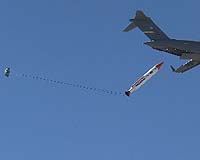
Kirkland WA (SPX) Nov 07, 2005 AirLaunch announced that it has been selected for contract continuance by the Defense Advanced Research Projects Agency (DARPA) under Phase 2B of the Falcon program. Valued at $17.8 million for a one-year effort, the Phase 2B contract activity enables AirLaunch and its team of contractors to continue development of the QuickReach small satellite booster. The Falcon program goal is to develop a booster that can launch a small satellite for less than $5 million with only 24 hours notice. AirLaunch's design achieves responsiveness by carrying its QuickReach booster to altitude inside the cargo bay of an unmodified C-17A or other large cargo aircraft. "We look forward to working with the DARPA/Air Force team to move the QuickReach booster development forward and bring the nation's first air-launched liquid rocket booster to fruition," said Gary Hudson, founder and Chairman of AirLaunch. "In Phase 2A, AirLaunch rapidly designed a prototype rocket, integrated a mock-up with an unmodified C-17 aircraft, and successfully executed a drop test of the hardware. Phase 2B will focus on additional risk reduction and maturing the launch vehicle design and concept of operations." AirLaunch and its team of contractors recently completed Phase 2A of the program, culminating with the company demonstrating the safe release of a dummy booster from an Air Force C-17A cargo plane. During Phase 2B, AirLaunch will conduct further risk reduction activities (including additional C-17 drop tests and an integrated stage-two firing), provide an initial Interface Control Document (ICD) for a payload, and complete a Critical Design Review (CDR). The contract includes an option for Phase 2C, to conduct a flight demonstration of the QuickReach booster and launch a small payload into Low Earth Orbit (LEO). In fall 2003, DARPA and the U.S. Air Force challenged nine U.S. competitors to develop a small launch vehicle that can carry small satellites to orbit for no more than $5 million per launch based on a rate of 20 flights per year. In mid-2004, AirLaunch and three other contractors were selected for Phase 2A. "The AirLaunch concept will enable tremendous flexibility for deploying satellites anywhere and anytime," said Debra Facktor Lepore, President of AirLaunch. "I'm especially excited that we will manage the program from our new headquarters in Kirkland, Washington." Related Links AirLaunch SpaceDaily Search SpaceDaily Subscribe To SpaceDaily Express  Russian Rocket To Fly Again Following Crash
 Moscow (AFP) Nov 07, 2005
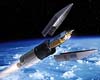
A ban on further flights of a Russian rocket following last month's crash of a 140-million-euro (170-million-dollar) satellite has been lifted, the launcher's developers said Monday. |
|
|

| The content herein, unless otherwise known to be public domain, are Copyright 1995-2006 - SpaceDaily.AFP and UPI Wire Stories are copyright Agence France-Presse and United Press International. ESA PortalReports are copyright European Space Agency. All NASA sourced material is public domain. Additionalcopyrights may apply in whole or part to other bona fide parties. Advertising does not imply endorsement,agreement or approval of any opinions, statements or information provided by SpaceDaily on any Web page published or hosted by SpaceDaily. Privacy Statement |