
 |
 |
 |
 |
 |
 |
 |
 |
 |
 |

| . |  |
. |

Pasadena CA (JPL) Mar 21, 2011 Hopes for reviving NASA's Spirit Mars rover dimmed further with passage last week of the point at which the rover's locale received its maximum sunshine for the Martian year. The rover team has tried to contact Spirit for months with strategies based on the possibility that increasing energy availability might wake the rover from hibernation. The team has now switched to communication strategies designed to address more than one problem on the rover. If no signal is heard from Spirit in the next month or two, the team at NASA's Jet Propulsion Laboratory, Pasadena, Calif., will shift to single-rover operations, continuing to operate Spirit's active twin, Opportunity. "The commands we are sending starting this week should work in a multiple-fault scenario where Spirit's main transmitter is no longer working and the mission clock has lost track of time or drifted significantly," said JPL's John Callas, project manager for Spirit and Opportunity. Spirit landed on Mars Jan. 4, 2004 Universal Time (Jan. 3, Pacific Time) for a mission designed to last for three months. After accomplishing its prime-mission goals, Spirit worked for more than five years in bonus-time extended missions. Spirit has not communicated since March 22, 2010. Power output from its solar array had been waning prior to that, and the rover had been expected to go into a low-power hibernation mode. With drive motors on two of its six wheels no longer working, Spirit had been unable in preceding months to maneuver much in its sand-trap location. The rover could not get to a favorable tilt for its solar panels as Martian winter approached. During the Martian winter with most heaters turned off, Spirit experienced colder internal temperatures than in any of its three previous winters on Mars. The cold could have damaged any of several electronic components that, if damaged, would prevent reestablishing communication with Spirit. However, attempts to regain contact have continued for more than eight months in the possibility that the seasonal increase in solar energy available at Spirit's location would revive the rover. NASA's Deep Space Network of antennas in California, Spain and Australia has been listening for Spirit daily. The rover team has also sent commands to elicit a response from the rover even if the rover has lost track of time, or if its receiver has degraded in frequency response. The available solar energy at Spirit's site was estimated to peak on March 10. Revised commanding began March 15, including instructions for the rover to be receptive over UHF relay to hailing from the Mars orbiters for extended periods of time and to use a backup transmitter on the rover. Spirit and Opportunity both have made important discoveries about wet environments on ancient Mars that may have been favorable for supporting microbial life. Opportunity landed three weeks after Spirit.
Share This Article With Planet Earth
Related Links Mars Rovers at JPL Mars Rovers at Cornell Mars News and Information at MarsDaily.com Lunar Dreams and more

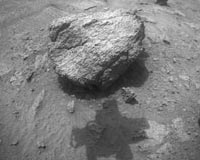 Opportunity Completes Study Of Ruiz Garcia Rock
Pasadena CA (JPL) Mar 21, 2011 Opportunity completed the in-situ (contact) investigation on the surface target Ruiz Garcia at Santa Maria crater. On Sol 2520 (Feb. 25, 2011), the rover used the robotic arm (Instrument Deployment Device, or IDD) to collect a microscopic imager (MI) image mosaic of Ruiz Garcia. Then, it placed the alpha particle X-ray spectrometer (APXS) down on the target for multi-sol integration. ... read more |
|
|
| The content herein, unless otherwise known to be public domain, are Copyright 1995-2010 - SpaceDaily. AFP and UPI Wire Stories are copyright Agence France-Presse and United Press International. ESA Portal Reports are copyright European Space Agency. All NASA sourced material is public domain. Additional copyrights may apply in whole or part to other bona fide parties. Advertising does not imply endorsement,agreement or approval of any opinions, statements or information provided by SpaceDaily on any Web page published or hosted by SpaceDaily. Privacy Statement |

 del.icio.us
 Digg
Digg Reddit
 YahooMyWeb
 Google
 Facebook







